
Your car got hit. The repair shop fixed the bumper, replaced the sensors, and handed the keys back with a clean bill of health. But something the insurance company will never bring up on their own is what happens to your vehicle’s resale value when buyers see that accident flag on the Carfax and know the vehicle needed ADAS calibration after a collision. In the current market in North Carolina and South Carolina, that combination of factors is driving diminished value losses that most drivers never recover because they did not know to claim them.
What ADAS Actually Is and Why It Changes the Repair Equation
ADAS stands for Advanced Driver Assistance Systems. It is the umbrella term for the radar, camera, ultrasonic, and lidar-based technologies built into most vehicles sold after 2018: automatic emergency braking, lane departure warnings, blind spot monitoring, adaptive cruise control, rear cross-traffic alerts, and parking assistance, among others.
These systems depend on sensors mounted in specific locations with extreme precision. A camera behind the rearview mirror must point at a calibrated angle. A radar behind the front bumper must be aligned within fractions of a degree. When a collision deforms any part of the vehicle structure near these sensors, that precision is gone. It does not come back just because the body panel was straightened or replaced.
A vehicle that received a new bumper cover after a rear-end collision but was never recalibrated for its backup camera and cross-traffic radar is not fully repaired. It is a liability on four wheels, and the market knows it.
The Three Types of ADAS Calibration Repairs
Not every shop handles ADAS recalibration the same way. Understanding the difference matters both for safety and for your diminished value claim.
| Calibration Type | How It Works | When Required |
|---|---|---|
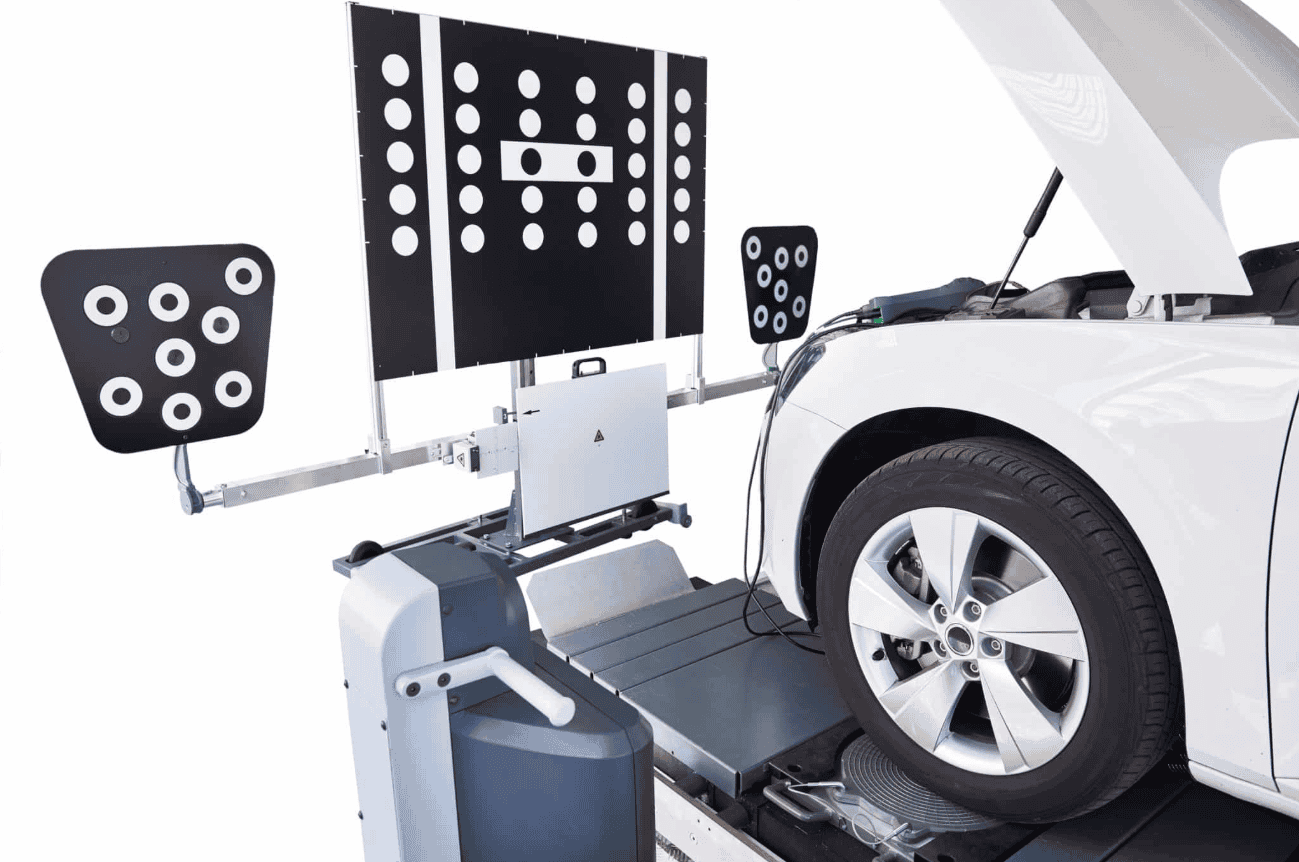
| Static Calibration | Vehicle parked in a controlled environment with reference targets; sensors adjusted to manufacturer spec | After windshield replacement, front camera or radar replacement |
| Dynamic Calibration | Vehicle driven at specific speeds on open roads while the system self-corrects using lane markings | After wheel alignment changes, some radar systems |
| Combined Calibration | Both static and dynamic required in sequence | Major front or rear structural repairs |
When a shop performs calibration correctly and documents it, that record becomes part of your repair history. When calibration is skipped, performed incorrectly, or left undocumented, the vehicle history is incomplete and buyers price that uncertainty into their offers.
Why ADAS History Amplifies Diminished Value
Diminished value is the permanent reduction in a vehicle’s market value that results from its accident history, even after repairs are complete. In NC and SC, drivers whose vehicles were hit by an at-fault party have the right to pursue that loss from the other driver’s liability coverage. What most people do not realize is that ADAS involvement in a repair increases that loss in ways the standard insurer formula does not capture.
Buyer Psychology Around Sensor Systems
When a sophisticated buyer sees ADAS repairs on a vehicle history report, they are not just looking at a line item. They are asking questions that have no easy answers from the report itself: Was the calibration done at a factory-authorized facility? Were OEM sensors used or aftermarket replacements? Was the calibration verified with a scan tool output matching manufacturer specs? Was there any bracket deformation that could affect long-term sensor alignment?
None of those answers appear in a standard vehicle history report. That ambiguity alone is worth money to a cautious buyer, and they will negotiate to reflect it.
The Insurance Company’s Standard Approach Misses This
Insurers use valuation tools like CCC One and Mitchell to estimate diminished value. Those platforms are built on broad depreciation models and comparable sales data. They are not designed to account for the specific market penalty that ADAS-related repairs carry in 2026, particularly on vehicles where the buyer pool is more sophisticated: late-model SUVs, trucks, and luxury sedans.
The result is a settlement offer that applies a generic percentage to the repair cost without reflecting what a real buyer in Charlotte, Raleigh, or Greenville will actually pay when ADAS calibration appears in the repair history.
NC and SC Fault Rules and How They Apply Here
The same fault rules that govern standard diminished value claims apply when ADAS repairs are involved. North Carolina’s contributory negligence standard means that if you had any share of fault in the accident, your third-party claim is at serious risk. South Carolina’s modified comparative fault system allows recovery as long as you were less than 51% at fault, with a proportional reduction applied to your recovery.
For a full breakdown of how fault assignment works in both states, the guide on diminished value claims in the Carolinas in 2026 covers the current legal framework and what it means for your situation.
If the accident was not your fault and your vehicle needed any ADAS repair or recalibration, you have a stronger diminished value claim than the standard insurer formula will produce. Document everything before you accept a settlement.
What to Document When ADAS Repairs Are Involved
The strength of your diminished value claim depends on the paper trail. ADAS-related claims require more specific documentation than a typical panel replacement, and the gap between a well-documented file and a vague one directly affects the settlement number.
- The complete repair order. Every sensor replaced, every calibration performed, and the method used (static, dynamic, or both) should appear in line-item detail. If your shop handed you a summary invoice without itemization, request the full work order.
- Calibration verification reports. Reputable shops that perform ADAS calibration will have a printed or digital scan tool output showing pre- and post-calibration values. This proves the work was done to spec, not just noted on the invoice.
- OEM vs. aftermarket notation. If your insurer authorized aftermarket sensors instead of OEM, document which parts were used. That distinction matters directly for resale value.
- Manufacturer service bulletins. Some manufacturers issue specific procedures for post-collision ADAS recalibration. If your vehicle has one and the shop followed it, include that documentation in your file.
- An independent appraisal. A general repair invoice is not a valuation. A professional appraisal translates the repair history into a specific market value loss figure you can put in front of an adjuster.
For more on how to structure your evidence before engaging with the insurer, the guide on how to prove and maximize a diminished value claim in the Carolinas walks through the full process.
Which Vehicles Are Most Affected
Not every ADAS-equipped vehicle carries the same market penalty after a collision. The loss is most pronounced where buyer expectations are highest and the technology is most complex.
- Late-model trucks and SUVs. The segment with the most ADAS hardware and the most buyer scrutiny in the Carolina market. A 2022 or newer F-150, RAM 1500, or Silverado with rear collision damage and camera or radar recalibration in its history will face meaningful price resistance from informed buyers.
- Luxury and near-luxury sedans and crossovers. Buyers in this segment are more research-oriented and more likely to pull a detailed vehicle history before negotiating.
- EVs and hybrids. ADAS systems on electric vehicles are often more deeply integrated with the vehicle’s primary control systems. Repair complexity is higher, documentation expectations from buyers are greater, and the pool of qualified repair shops is narrower.
- Any vehicle with a front-end collision requiring windshield replacement. Virtually every vehicle with a forward-facing camera requires full static recalibration after windshield replacement. This is a frequent repair that is frequently under-documented.
For trucks and SUVs specifically, the breakdown on why trucks and SUVs lose more to diminished value after an accident in NC and SC covers the segment-level data in detail.
What a Professional Appraisal Adds to an ADAS Claim
An independent appraiser evaluating an ADAS-involved vehicle is not just running a comparable sales analysis. They are accounting for the specific market discount that buyers apply to vehicles with complex electronic repair histories in the current Carolina used car market.
The difference between a generic insurer formula and a professional appraisal on an ADAS claim is not a rounding error. On a $35,000 vehicle with documented radar and camera recalibration after a moderate rear-end collision, the gap between what an insurer formula produces and what a real buyer will actually pay can be $3,000 to $6,000 or more. That is money the insurer is counting on you not knowing to claim.
The diminished value calculator gives you a baseline estimate before you engage with the adjuster. It is not a substitute for a full appraisal, but it tells you whether the number is worth pursuing and what range to expect.
Your ADAS Repair May Be Worth More Than the Insurer Offered
Get a free quote and find out exactly what your vehicle lost in market value after the collision. Carolina drivers with ADAS-equipped vehicles are leaving real money unclaimed.Get Your Free Quote
Download This Guide as a PDF Save or share this article: ADAS Calibration After a Collision: How It Affects Diminished Value in NC and SC (PDF)
Frequently Asked Questions
Does ADAS recalibration automatically increase my diminished value claim?
Not automatically, but it strengthens it. ADAS recalibration in your repair history signals to potential buyers that the vehicle sustained damage to sensor-critical areas. That uncertainty carries a real market price. A professional appraisal quantifies the loss. Without one, the insurer will apply a generic formula that ignores the ADAS factor entirely.
What if the repair shop says the ADAS was calibrated but has no documentation?
Verbal confirmation is not enough. Request the scan tool output or calibration verification report in writing before you accept the vehicle back. If the shop cannot produce it, the calibration cannot be confirmed for any future buyer or insurer, which itself becomes a relevant factor in your diminished value claim.
Can I still file a diminished value claim if the accident happened several months ago?
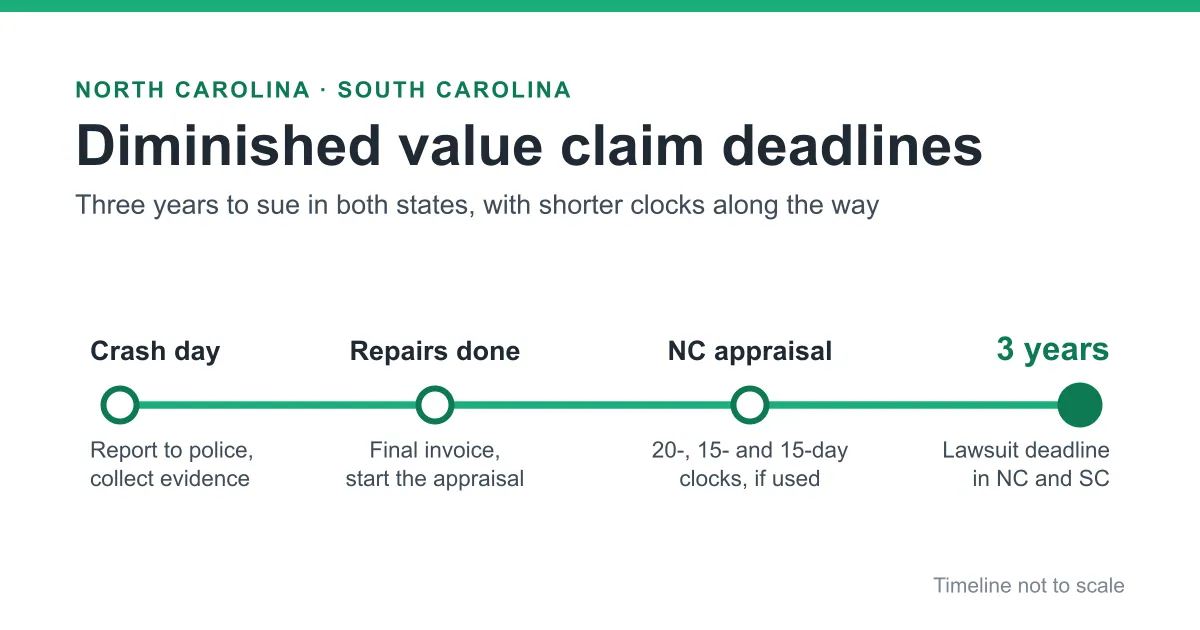
Yes. Both NC and SC allow three years from the date of the accident to file a property damage claim. However, the sooner you file, the stronger the evidence. Repair records are easier to obtain, market comparables are more current, and the connection between the accident and the value loss is cleaner to document.
Does it matter if aftermarket sensors were used instead of OEM?
It matters significantly. OEM sensors are manufactured to exact factory specifications. Aftermarket sensors vary in quality and are viewed skeptically by sophisticated buyers, particularly on newer or higher-value vehicles. If your insurer authorized aftermarket parts, document it. That is a legitimate element of your diminished value claim.
What if my insurer says the ADAS was repaired properly and denies the diminished value?
A proper repair does not eliminate diminished value. The accident remains on the vehicle’s history regardless of repair quality. The market discounts vehicles with accident history because of the uncertainty involved, not just the severity of the damage. An independent appraisal is your primary tool for challenging a denial based on repair quality arguments.