
Record numbers of vehicles are being declared total losses across the United States, and Carolina drivers are caught in the middle of it. According to industry data, total loss frequency reached 22.8% in 2025, the highest figure ever recorded, and the trend is still climbing into 2026. For drivers in North Carolina and South Carolina facing the question of whether to keep their car after a total loss declaration, the answer involves far more than the settlement check. The title change alone can cost you thousands in future value, and most people do not realize it until they try to sell, finance, or insure the vehicle down the road.
This guide walks through what is driving the surge in total losses, what the buyback decision actually costs you in the Carolinas, and where diminished value fits into the picture for vehicles that barely avoid being totaled.
Why Total Loss Declarations Are Hitting Record Numbers
The formula behind a total loss declaration is simple in theory: when the cost to repair your vehicle exceeds a set percentage of its pre-accident market value, the insurer declares it a total loss. But the variables feeding that formula have all shifted in the same direction at once.
Average collision repair costs reached between $4,500 and $5,000 in 2025, nearly double the $2,500 average from just 15 years earlier. A significant factor is vehicle technology. More than 28% of repairable estimates now include at least one ADAS sensor calibration, a procedure that adds hundreds of dollars per job and requires equipment that many shops still do not have. Calibration fees alone have nearly doubled in five years, averaging roughly $500 per repairable vehicle.
The 25% tariff on imported auto parts, in effect since mid-2025, has compounded the problem. Replacement parts cost more across the board, from brake components to electronic modules. When parts cost more, more vehicles cross the total loss threshold, even when the visible damage looks repairable.
At the same time, the U.S. vehicle fleet continues to age. Older vehicles carry lower market values, which means even a moderate repair bill can tip the scale. The result is a compounding effect: repairs cost more, vehicles are worth less, and insurers are declaring total losses at rates that have never been this high.
How Total Loss Settlements Work in NC and SC
When your insurer declares your vehicle a total loss, they owe you the actual cash value (ACV) of your car immediately before the accident. That is not the replacement cost, the original purchase price, or what you still owe on your loan. It is what your specific vehicle, with its exact mileage, condition, options, and local market position, was worth the moment before the collision.
Insurers typically use proprietary tools like CCC One or Mitchell to calculate that number. These tools pull from recent sales and listings, but the valuations are not always accurate. Comparable vehicles may be sourced from markets hundreds of miles away, condition adjustments may not reflect your car’s actual maintenance history, and pricing trends specific to the Charlotte, Raleigh, or Charleston markets may be underweighted.
In both North Carolina and South Carolina, you have the right to dispute the settlement. Most auto policies include an appraisal clause that lets you bring in an independent appraiser. Understanding your vehicle’s fair market value after a car accident is the foundation of any effective dispute. The gap between the insurer’s first offer and a properly documented valuation can run into the thousands.
The Buyback Decision: What Keeping Your Totaled Car Really Costs
Many Carolina drivers choose to keep their vehicle after a total loss, especially when the car is still driveable and the settlement would not cover an equivalent replacement. The insurer deducts the salvage value from your check and you keep the car. Simple enough on paper. What most people do not fully grasp is what happens next.
Your Title Changes Permanently
Once a total loss is declared, your clean title is canceled and replaced with a salvage title. In North Carolina, this is processed through the NCDMV. In South Carolina, through the SCDMV. A salvage title vehicle cannot be legally driven or registered until it is repaired, inspected, and issued a rebuilt title.
That rebuilt designation is permanent. It will appear on every Carfax and AutoCheck report for the life of the vehicle. Every future buyer, lender, and insurer will see it. The word “rebuilt” follows the VIN, not the owner.
The Financial Hit Is Measurable
| Area | Impact of Salvage or Rebuilt Title |
|---|---|
| Resale Value | Typically 20% to 40% below a comparable clean-title vehicle |
| Financing | Most traditional lenders will not finance a rebuilt title vehicle |
| Insurance | Many carriers limit coverage to liability only; full coverage is harder to find |
| Warranty | Factory warranties are typically void after a salvage declaration |
| Vehicle History | Salvage and rebuilt flags appear permanently in all reports |
On a vehicle worth $22,000 before the accident, a 30% resale discount translates to $6,600 in lost future value. That is money you will never recover, and it is entirely separate from whatever the insurer pays you in the settlement. For a detailed look at how total loss thresholds work across the country, the total loss threshold by state guide from Total Loss Appraisals breaks down the numbers.
When Keeping the Car Makes Financial Sense
Keeping a totaled vehicle is not always the wrong decision. It can work in your favor when:
- The vehicle is paid off and you do not need financing to cover the repair
- Repair costs are manageable and the car is structurally sound
- You plan to drive it long-term and resale is not a priority
- The settlement minus the salvage deduction still covers your out-of-pocket repair costs
- You can secure adequate insurance coverage on a rebuilt title in your state
It does not make sense when:
- You still owe money on the vehicle and the settlement leaves a gap
- The structural damage is significant enough to raise safety concerns
- You need full coverage and your carrier will not write it on a rebuilt title
- You plan to sell or trade the vehicle within a few years
The decision comes down to math with honest inputs. If you are not confident about what your vehicle was actually worth before the accident, a professional appraisal gives you the baseline number you need to evaluate whether the buyback makes sense. The breakdown of how insurers calculate total loss value explains exactly where those numbers come from and where they tend to fall short.
The Borderline Cases: When Your Car Is Almost Totaled but Gets Repaired
This is where diminished value enters the picture. If your vehicle’s repair cost comes in just below the total loss threshold, the insurer authorizes the repair instead of writing it off. You get your car back with a clean title, but the accident is now part of its permanent history.
That history reduces what your vehicle is worth on the open market. Buyers pay less for cars with reported collisions, regardless of how well the repair was executed. The gap between what your car would have been worth without the accident and what it is actually worth now is your diminished value.
In both North Carolina and South Carolina, you have the right to file a diminished value claim against the at-fault driver’s liability insurance. The closer your repair bill was to the total loss threshold, the stronger your case tends to be, because the severity and extent of the damage is thoroughly documented in the repair order. Learning how to prove and maximize a diminished value claim before you engage with the adjuster makes a measurable difference in the outcome.
Vehicles that were nearly totaled but ultimately repaired often carry the highest diminished value losses. The repair bill itself proves the severity of the damage, and the accident history ensures buyers will discount the car at resale. If your repair was extensive, your DV claim is likely stronger than you think.
If you are not sure whether your situation qualifies, the diminished value calculator provides a working estimate based on your vehicle’s specifics.
Protecting Yourself Before You Sign Anything
Whether your car is totaled or repaired, the insurer’s first offer is rarely the best one. Here is what Carolina drivers should do before making any decisions:
- Request the full valuation report (CCC One or Mitchell) and review every comparable vehicle used in the calculation.
- Do not accept the settlement without verifying it against current local market data from your area, not from a database pulling comps from three states away.
- If you plan to keep the vehicle, calculate the full cost: repairs, state inspection fees, rebuilt title processing, insurance premium changes, and the resale value reduction you will absorb later.
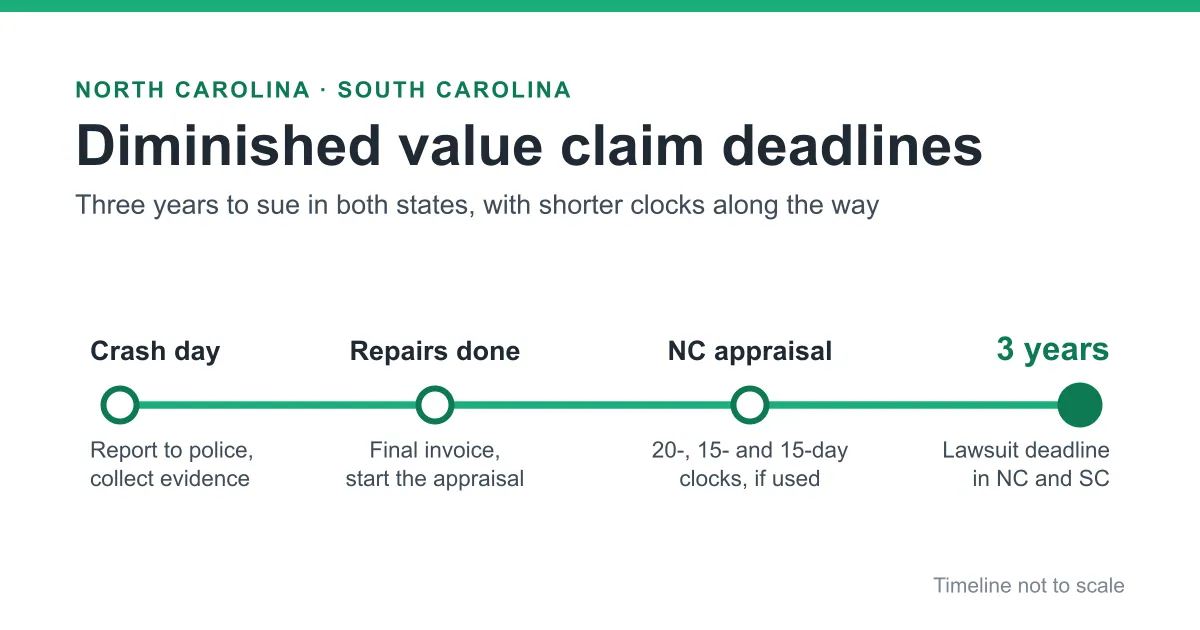
- If your car was repaired instead of totaled, document everything and pursue a diminished value claim before the statute of limitations expires. In both NC and SC, you generally have three years.
- Get an independent appraisal regardless of which scenario you are in. Total loss disputes and diminished value claims both depend on having a defensible, documented number that the insurer cannot simply dismiss.
For drivers in the Carolinas navigating a total loss or a high-dollar repair, understanding your vehicle’s actual market value before and after the accident is the foundation of every financial decision you will make from this point forward. Current market conditions, from dropping wholesale prices to rising repair costs, make that number more volatile and more important than in years past.
Not Sure What Your Vehicle Is Worth After the Accident?
Whether your car was totaled or repaired, get a free estimate from Carolina’s most trusted vehicle appraisers. Know your number before you negotiate. Get Your Free Quote
Download This Article as a PDF
Save or share this guide for reference. Download PDF
Frequently Asked Questions
What is the total loss threshold in North Carolina and South Carolina?
North Carolina uses a 75% threshold, meaning the insurer can declare a total loss when repair costs reach 75% of the vehicle’s actual cash value. South Carolina uses a total loss formula that compares the combined repair cost and salvage value against the vehicle’s ACV. Both approaches are designed to identify when repairing the vehicle no longer makes economic sense for the insurer.
Can I negotiate a total loss settlement in the Carolinas?
Yes. The insurer’s first offer is based on their internal valuation tools, which may not reflect your vehicle’s true local market value. You have the right to request the full valuation report, challenge the comparable vehicles used, and submit your own market data or an independent appraisal to support a higher number.
If I keep my totaled car, can I still file a diminished value claim?
Diminished value claims apply to vehicles that are repaired and retain a clean title. Once your car is declared a total loss and receives a salvage or rebuilt title, the DV claim path does not typically apply. Your financial recovery in a total loss scenario comes through negotiating or disputing the ACV settlement itself.
How long do I have to dispute a total loss settlement in NC or SC?
Both states generally allow three years for property damage claims. That said, acting quickly produces a stronger result. Market data, repair records, and comparable vehicle listings become harder to obtain the longer you wait, and the insurer’s offer becomes harder to challenge without fresh evidence.
Does keeping my totaled car affect my insurance rates?
It can. Once your vehicle carries a rebuilt title, some insurers will not offer comprehensive or collision coverage at all. Those that do may charge higher premiums and apply reduced payout limits if the car is damaged again. Your rates will also reflect the total loss claim itself, regardless of whether you keep the vehicle or not.