
When a truck or SUV gets hit, the damage estimate is only part of what the owner loses. The other part is quieter and almost never shows up in the repair paperwork: the permanent drop in resale value that follows the vehicle’s accident history for as long as it exists. In North Carolina and South Carolina, where pickups and SUVs make up a massive share of registered vehicles, diminished value claims on these vehicle types are both more common and more valuable than most drivers ever realize.
The financial hit is not the same across the board. Trucks and SUVs, by their nature, tend to suffer a steeper diminished value loss after a collision than smaller sedans or economy cars. Understanding why that is the case, and how to document it properly, is the difference between walking away whole or absorbing a loss that was never yours to take.
Why Vehicle Type Matters in a Diminished Value Claim
Diminished value is calculated as a percentage of a vehicle’s pre-accident fair market value. That means the higher the starting value, the larger the potential dollar loss. Trucks and SUVs tend to command strong resale prices in the Carolinas market, and that works both ways. The more a vehicle was worth before the accident, the more it can lose.
But it is not just about starting value. Buyers and dealers in the used market apply a sharper discount to trucks and SUVs with accident history than they do to comparable sedans. There are a few reasons for this.
Trucks are frequently used for towing, hauling, and off-road driving. A buyer who plans to put a vehicle to that kind of use is not willing to pay full price for one that has been in a collision, even a fully repaired one. The concern is not cosmetic. It is structural, especially if the frame or suspension was involved. That concern has a dollar value, and it comes out of your asking price.
SUVs, particularly family-oriented ones, carry a similar dynamic. Buyers who purchase them for safety and reliability will pay less for one with an accident record, even if every repair was done correctly. The vehicle history report tells the story, and buyers read it.
The Carolinas Market Amplifies the Loss
North and South Carolina are truck-heavy markets. Pickups like the Ford F-150, Ram 1500, and Chevy Silverado consistently rank among the top-selling vehicles in both states. Full-size and mid-size SUVs are not far behind. These vehicles hold value well in a clean-title market, which is exactly what makes accident history so costly.
A clean F-150 with 35,000 miles might sell for $38,000 in the Charlotte or Raleigh area. The same truck with a reported collision, even one that was repaired at a certified shop, could realistically sell for $6,000 to $12,000 less, depending on severity, what was damaged, and current market conditions. That range is not a guess. It reflects the actual buyer behavior in the used truck market, and how accident history affects resale value in practice.
A fully repaired truck is still a truck with an accident on its Carfax. No amount of bodywork changes that record, and buyers in the Carolinas market price it accordingly.
The 2026 used car market has made this worse. As used vehicle prices soften overall, buyers have more negotiating leverage, and accident history gives them an easy anchor to pull the price down further. The window for recovering full diminished value is tightest when you act early, before the market absorbs more depreciation on top of the accident discount.
What Types of Damage Hit Trucks and SUVs Hardest
Not all collision damage produces the same diminished value outcome. For trucks and SUVs specifically, certain damage categories create disproportionate losses in the resale market.
Frame and Structural Damage
Body-on-frame trucks, which includes most full-size pickups, are particularly sensitive to frame damage. Even a professionally repaired frame raises serious concerns for buyers who plan to tow or haul. If a vehicle history report flags structural repair, expect a significant discount. This applies to unibody SUVs as well, where structural repairs affect rigidity and safety ratings in ways that buyers cannot fully verify.
Suspension and Axle Involvement
Trucks used for towing or off-road driving depend on suspension integrity in ways that matter to the buyer pool. A collision that touched the front axle, control arms, or differential creates lingering doubt that drives resale prices down well beyond the repair cost.
Airbag Deployment
Any collision severe enough to deploy airbags is going to show in the vehicle history. Airbag deployment signals a high-impact event to every future buyer. Airbag deployment has a measurable effect on diminished value claims and is one of the factors that consistently pushes the loss percentage higher on trucks and SUVs.
ADAS and Camera Systems
Modern trucks and SUVs are loaded with driver assistance technology: forward collision warning, lane keep assist, blind spot monitoring, and towing cameras. A collision can disrupt or damage these systems even when body repairs look perfect. Recalibration is not always documented correctly, and buyers of late-model trucks pay attention to whether all systems are functioning properly. Incomplete ADAS documentation after a repair reduces buyer confidence and resale price.
Dollar Estimates: How Much Can Trucks and SUVs Lose?
The numbers vary by make, model, severity of damage, and repair quality, but the ranges below reflect realistic diminished value outcomes for common truck and SUV categories in the Carolinas market.
| Vehicle Type | Approx. Pre-Accident Value | Typical DV Loss Range | Estimated Dollar Loss |
|---|---|---|---|
| Full-size pickup (F-150, Ram 1500, Silverado) | $32,000 – $52,000 | 15% – 30% | $4,800 – $15,600 |
| Mid-size pickup (Tacoma, Ranger, Colorado) | $26,000 – $38,000 | 15% – 28% | $3,900 – $10,640 |
| Full-size SUV (Expedition, Suburban, Tahoe) | $40,000 – $68,000 | 18% – 35% | $7,200 – $23,800 |
| Mid-size SUV (Explorer, Highlander, Pathfinder) | $28,000 – $44,000 | 15% – 28% | $4,200 – $12,320 |
| Compact SUV / Crossover (CR-V, RAV4, Escape) | $22,000 – $34,000 | 12% – 22% | $2,640 – $7,480 |
These ranges assume moderate to significant collision damage with professional repairs. Minor damage with no structural involvement produces lower DV losses. Frame involvement or airbag deployment pushes the percentages toward the higher end. A professional appraisal is the only way to get a documented, defensible number for your specific vehicle and situation.
NC vs. SC: Fault Rules Still Apply
Before pursuing a diminished value claim on your truck or SUV, the fault question has to be clear. North Carolina’s contributory negligence rule means that any assigned fault on your part can block the entire third-party claim. South Carolina’s modified comparative fault system allows recovery if you were less than 51% responsible, but reduces your payout proportionally.
For a full breakdown of how fault affects your recovery in each state, see how at-fault vs. not-at-fault accidents affect your diminished value claim in the Carolinas.
If the other driver was at fault and their liability coverage is responsible, you have a clear path to file. The size of the recovery depends on having an independent appraisal that accurately captures what your truck or SUV actually lost in market value, not what an insurer’s formula suggests.
Why Insurers Undervalue Truck and SUV Diminished Value Claims
Insurance companies routinely apply the 17c formula to diminished value claims. This formula caps the base loss at 10% of the vehicle’s value, then applies multipliers for damage severity and mileage that consistently produce results well below the real market impact, especially on high-value vehicles like trucks and SUVs.
On a $45,000 pickup with significant collision damage, the 17c formula might generate a diminished value figure of $2,000 to $3,000. An independent market-based appraisal on the same vehicle, using real comparable sales from Carolina dealers and private listings, might document a loss of $8,000 to $12,000. That gap is real money, and it belongs to you.
The 17c formula was never a legal standard. It is an internal insurer tool designed to limit payouts. You are not required to accept it, and an independent appraisal is the most direct way to challenge it.
A documented appraisal from a certified independent appraiser gives you a specific dollar figure backed by actual market data. It is the basis for a formal demand letter, and it is what moves the conversation from the insurer’s math to your math. For the full picture on how to prove and maximize a diminished value claim, review our detailed guide before you engage with the adjuster.
What to Do After Your Truck or SUV Is Repaired
Once repairs are complete, the clock is ticking. Waiting too long makes it harder to document the connection between the accident and the value loss. Here is the sequence that protects your claim:
- Get complete repair documentation. The detailed repair order, line by line, including every panel, component, and calibration performed. This is the foundation of any appraisal.
- Gather pre-accident value evidence. Black Book, NADA, and comparable active listings for your year, make, model, trim, and mileage in the Carolinas market at the time of the accident.
- Request an independent appraisal. Do not let the insurer be the only party measuring your loss. A certified appraiser working from real market data will produce a number that reflects what buyers in this market actually pay, and what they discount for accident history.
- File your claim with documentation in hand. The insurer will take a documented, appraised claim more seriously than a verbal demand. A formal demand letter accompanied by an independent appraisal is your strongest opening position.
For owners of higher-value trucks and SUVs in particular, the potential recovery justifies the cost of a professional appraisal many times over. The question is not whether to file. It is whether to file with the right tools or leave the number up to the insurer.
Find Out What Your Truck or SUV Claim Is Worth
High-value vehicles lose more to diminished value, and Carolina drivers with pickups and SUVs are often leaving thousands of dollars on the table. Get a free quote and find out exactly where you stand before you accept anything. Get Your Free Quote
📄
Download the PDF Version of This Guide
Save or share a formatted version of this article for future reference. Download PDF
Frequently Asked Questions
Do trucks and SUVs qualify for higher diminished value payouts than sedans?
Generally yes, because diminished value is calculated as a percentage of pre-accident market value, and trucks and SUVs tend to carry higher values. A 20% loss on a $45,000 pickup is $9,000. The same percentage on a $16,000 economy sedan is $3,200. Beyond the math, buyer psychology in the truck and SUV market also amplifies the discount for accident history, which drives real-world losses higher.
Does frame damage automatically disqualify my truck from a diminished value claim?
No. Frame damage actually strengthens your claim because it documents a higher-severity event and justifies a larger loss percentage. Buyers of trucks with prior frame damage apply steep discounts regardless of repair quality, which is exactly what diminished value compensates for. An independent appraisal will document the market impact of the structural history specifically.
Can I file a diminished value claim on my truck in North Carolina if I was not at fault?
Yes, as long as no fault was assigned to you. North Carolina’s contributory negligence rule means that any percentage of fault on your part can bar the third-party claim entirely. If the accident report and insurance determination confirm the other driver was fully responsible, you have a clear basis to file against their liability coverage for diminished value.
How long do I have to file a diminished value claim on my SUV in South Carolina?
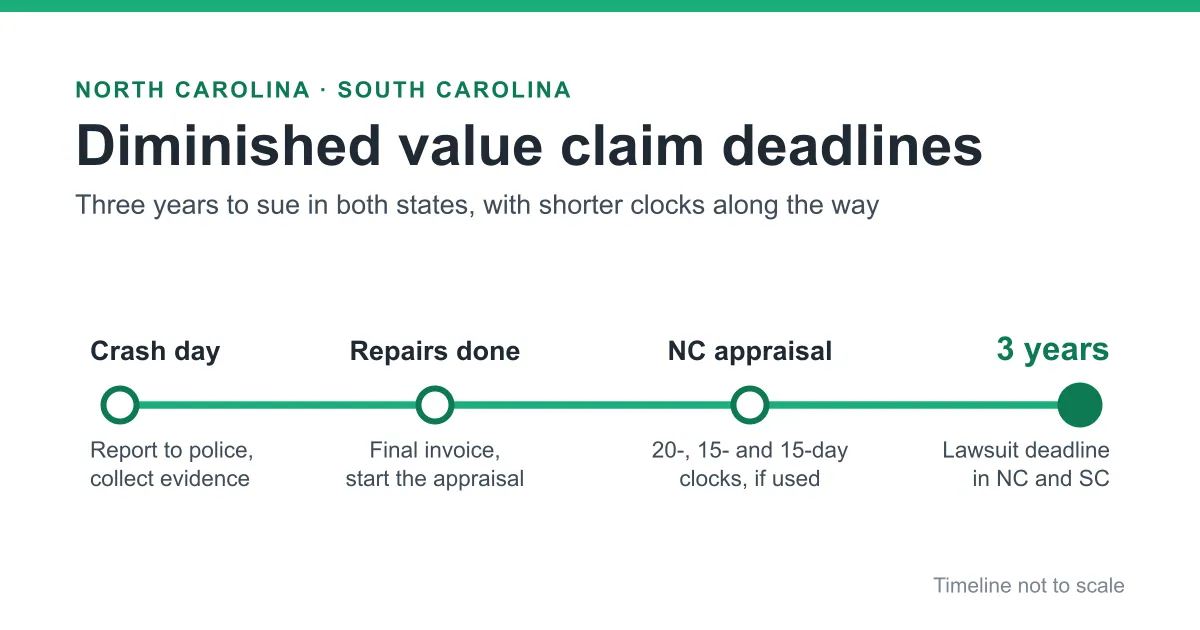
South Carolina generally allows three years from the date of the accident to file a property damage claim. However, waiting weakens your case. Repair records become harder to obtain, and establishing the pre-accident market value becomes more difficult as time passes. Filing as soon as repairs are complete gives you the cleanest documentation and the strongest negotiating position.
Will the insurer use the 17c formula on my truck claim even if the loss is clearly much higher?
In most cases, yes. The 17c formula is the default tool many insurers apply to diminished value claims because it consistently produces lower numbers, especially on high-value vehicles. On a $50,000 truck, the formula might cap the loss well below what the real market impact would be. An independent appraisal based on actual comparable sales is the counterweight to that formula and gives you a defensible number to negotiate from.