
If you were in an accident in North Carolina or South Carolina and your car has been repaired, you may be sitting on a financial loss you do not even know about yet. The used car market in 2026 is softening, and that shift makes the hit to your vehicle’s resale value bigger than it would have been a year or two ago. Diminished value was already real before prices started cooling. Now, with the used car market and diminished value in Carolina dynamic working against accident victims, the stakes are higher.
What Is Actually Happening to Used Car Prices Right Now
The numbers are official. According to the U.S. Bureau of Labor Statistics, the used cars and trucks index dropped 0.4 percent in March 2026 alone, and was listed among the major indexes that decreased that month. This is not a blip. It reflects a broader trend of price normalization after years of pandemic-era inflation that kept used vehicle prices artificially elevated.
The data source here matters. This is not a dealer estimate or a market opinion piece. The Consumer Price Index published by the Bureau of Labor Statistics is the federal government’s official measure of price change across the U.S. economy. When it says used car prices are falling, that reading carries weight.
On the industry side, J.D. Power projected at its Auto Summit in February 2026 that used vehicle values could decline approximately 4 percent year over year. The confluence of more off-lease vehicles returning to market, softening retail demand, and buyers taking longer to make decisions is pushing prices down across segments, with EVs and compacts absorbing the steepest drops.
Why this matters for Carolina drivers: When used car prices fall across the board, a vehicle with accident history does not just lose value relative to a clean-title car. It loses value relative to a market that is already moving downward. The gap between what your car is worth and what it would be worth without that accident record widens in a softer market.
How a Softer Market Amplifies Diminished Value
Diminished value is the difference between what your vehicle is worth after a fully completed repair and what it would be worth if the accident had never happened. Even a flawless repair job leaves behind an accident record on services like Carfax and AutoCheck. Buyers see that history. Dealers price against it. Private buyers negotiate hard because of it.
In a rising or stable market, buyers have less leverage. Inventory is tight, competition is high, and people accept imperfect vehicles because they do not have many other options. In a softening market, the dynamic flips. Buyers have more choices, they are pickier, and they are quicker to pass on a car with a reported accident. That makes your accident-history vehicle sit longer on the lot and sell for less.
For Carolina drivers, this plays out directly at the point of sale. Whether you are trading in at a dealer in Charlotte or selling privately in Columbia, buyers are doing their homework. A vehicle history report showing a prior collision is now a harder sell than it was in 2022 or 2023 when inventory was thin and buyers had little choice.
The Numbers Behind the Loss
How much can a prior accident reduce a vehicle’s value? It depends on the severity of the damage, the vehicle’s make and model, its pre-loss value, and current market conditions. The table below gives a general picture of how diminished value can look across different vehicle types in the current market environment:
| Vehicle Type | Pre-Loss Value (Approx.) | Estimated DV Range | Market Pressure (2026) |
|---|---|---|---|
| Compact / Sedan | $18,000 – $26,000 | $1,200 – $4,000 | High (segment softening) |
| SUV / Crossover | $28,000 – $45,000 | $2,500 – $7,500 | Moderate (demand still firm) |
| Pickup Truck | $35,000 – $55,000 | $3,000 – $9,000 | Moderate (trucks hold value) |
| Luxury Vehicle | $45,000 – $80,000+ | $5,000 – $15,000+ | High (buyer selectivity up) |
| Electric Vehicle | $32,000 – $60,000 | $3,500 – $10,000+ | Very High (EV prices dropping fast) |
DV ranges are estimates for illustration purposes. Actual diminished value depends on specific vehicle condition, repair quality, market comps, and a professional appraisal.
What Carolina Law Says About Your Right to Claim
Both North Carolina and South Carolina recognize the right to claim diminished value when the accident was caused by another driver. If someone else hit your car, their liability insurance is on the hook not just for repairs, but for the value your vehicle lost as a result of the accident record.
North Carolina operates under a pure contributory negligence standard, which is one of the strictest fault rules in the country. If you are found even partially at fault, your ability to recover can be significantly affected. This is a reason to act carefully and document everything from the start. South Carolina uses a comparative negligence system, which is more forgiving, but still requires you to build a credible claim with supporting documentation.
In both states, the insurer for the at-fault driver rarely volunteers to pay your diminished value without a formal claim backed by a professional appraisal. The burden of proof is on you. That means you need a documented, USPAP-compliant appraisal that establishes the pre-loss value of your vehicle and the measurable loss caused by the accident history. For a deeper breakdown of how fault rules affect your specific situation, see our guide on at-fault vs. not-at-fault accidents and diminished value in the Carolinas.
Why Timing Your Claim Matters More in a Softening Market
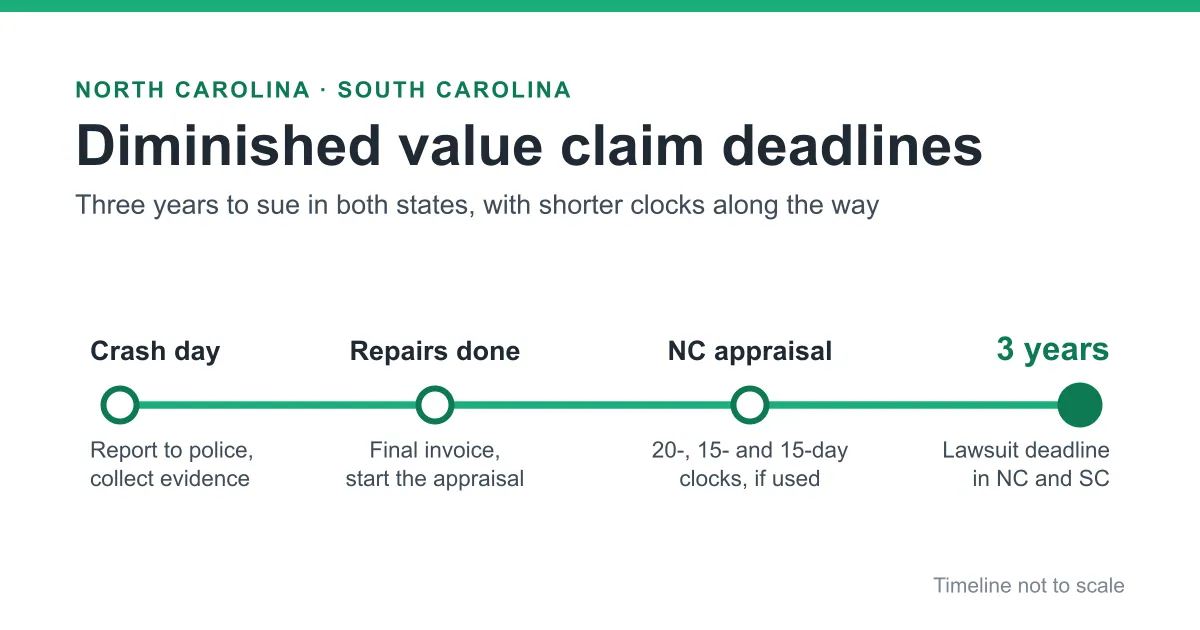
There are statutes of limitations on diminished value claims. In North Carolina, the window is generally three years from the date of the accident. In South Carolina, it is three years as well. But the fact that you technically have time does not mean waiting is a smart move.
Here is the practical reason to move sooner: your claim is anchored to what your vehicle was worth before the accident. As used car values continue to adjust downward, the pre-loss value your appraisal establishes may be lower if you wait. The larger the gap between when the accident happened and when you file, the harder it can be to accurately reconstruct the vehicle’s condition and value at the time of loss.
Beyond the valuation issue, insurers get more resistant over time. A fresh claim with documentation is harder to dismiss than a claim filed 18 months after the fact when the insurer will raise questions about condition, mileage, and whether any subsequent events affected the vehicle.
What a Professional Appraisal Does for Your Claim
Insurance adjusters use formulas that systematically undervalue diminished value. The most common one, the 17c formula, applies an arbitrary cap that limits your recovery to a fraction of what you actually lost. It was designed by and for insurers, and it does not reflect how buyers actually price accident-history vehicles in the real world.
A professional appraisal from a certified, independent appraiser uses actual market data to document what your vehicle is worth today versus what it would be worth without the accident record. That documentation is what gives you real leverage in a negotiation, and it is what a court or arbitrator will look at if the claim escalates. For more on how to build a strong claim, read our guide on how to prove and maximize a diminished value claim in the Carolinas.
The Market Shift Is Working Against You Unless You Act
The convergence happening right now is straightforward: used car values are declining, buyers have more options and are more selective, and vehicles with accident history are getting hit harder at resale. If your car was in a collision and the other driver was at fault, the time to move on your diminished value claim is not after prices fall further.
Insurers count on policyholders not knowing this. They count on time and confusion working in their favor. A professional appraisal flips that dynamic. It puts documented numbers on the table and forces the insurer to respond to facts, not formulas.
North Carolina and South Carolina drivers have the right to pursue this compensation. The market conditions in 2026 make the case for doing so more compelling, not less. See how diminished value claims are trending upward across the Carolinas in 2026 and why more drivers are taking action.
Find Out What Your Accident-History Vehicle Is Actually Worth
Get a free diminished value estimate from Carolina’s vehicle appraisal specialists. No obligation, no pressure. Get Your Free Quote
Download This Article as a PDF
Save it for reference or share it with someone who needs to file a claim.
Frequently Asked Questions
Does the declining used car market increase how much diminished value I can claim?
Not directly, but it makes the practical impact of your diminished value worse. When buyers have more choices and are more selective, a vehicle with an accident record is harder to sell and commands a lower price. The gap between your car’s actual market value and what it would be worth with a clean history widens in a softer market. A professional appraisal will capture those current market conditions when documenting your loss.
Can I file a diminished value claim in North or South Carolina if the accident was months ago?
Yes, as long as you are within the three-year statute of limitations from the date of the accident in either state. However, waiting can make the claim harder to build. The sooner you get a professional appraisal done, the more accurately it reflects your vehicle’s pre-loss value and condition. Delays give insurers more room to challenge the claim.
My insurance company offered me a settlement for diminished value already. Should I accept it?
Not before you get an independent appraisal. Insurers routinely use the 17c formula or similar methods that drastically undervalue your actual loss. An offer that seems reasonable on the surface may represent a fraction of what you are entitled to. Getting a professional appraisal first gives you a factual baseline to either accept the offer with confidence or push back with documentation. You can also read more about how to maximize your diminished value claim before accepting anything.
Does my vehicle need to be fully repaired before I file a diminished value claim in the Carolinas?
Yes, in most cases you need to have the repairs completed first. Diminished value is measured as the difference between the repaired vehicle’s market value and its pre-loss value. Without the repair being done, there is no baseline to calculate against. Once repairs are complete, you should request the full repair documentation from the shop and move quickly on your appraisal and claim.
What types of vehicles qualify for diminished value claims in NC and SC?
Most personal-use vehicles qualify as long as the accident was caused by another driver and the vehicle sustained documented damage that was repaired. This includes sedans, SUVs, trucks, luxury vehicles, and EVs. Some restrictions may apply to commercial vehicles or vehicles that were already significantly depreciated prior to the loss. See the full breakdown in our Carolina diminished value guide.