
If your car was damaged in an accident that was not your fault, you have the right to file a diminished value claim in North Carolina. But there is a legal trap that stops thousands of drivers from recovering what they are owed every year. North Carolina follows a doctrine called pure contributory negligence, and under this rule, if an insurance company can argue that you share even one percent of the blame for the accident, your claim may be denied entirely. No partial payment. No compromise. Zero. Understanding how this rule works, and what you can do about it, is the first step toward protecting your financial recovery after a collision.
What Is Contributory Negligence and Why Does North Carolina Still Use It?
Most states in the country use a system called comparative negligence. Under that system, if you were 20 percent at fault and the other driver was 80 percent at fault, you can still recover 80 percent of your damages. It is a proportional, common-sense approach to accident law.
North Carolina operates differently. The state still applies the doctrine of pure contributory negligence, one of the strictest liability standards in the United States. Under this rule, if you contributed to the accident in any way, even minimally, you are barred from recovering damages from the other party. North Carolina is one of only four jurisdictions in the country that still follows this approach.
Important: Insurance adjusters know this rule well, and they use it strategically. If they can find any reason to place even a fraction of fault on you, they have a legal basis to deny the entire claim. That includes your diminished value claim, not just injury or medical costs.
Recent changes to North Carolina’s insurance laws, including updated minimum liability limits and surcharge periods that took effect in 2025, have made the claims environment more complex. Bankrate’s analysis of North Carolina’s 2025 insurance law changes explains how these updates affect policy coverage and claim dynamics across the state. In this environment, understanding the fault rules is not optional. It is essential.
How This Rule Affects Your Diminished Value Claim Specifically
Diminished value is the difference between what your vehicle was worth before the accident and what it is worth after repairs. Even a perfectly repaired car carries an accident history that buyers can see on a vehicle history report, and that history reduces what someone is willing to pay. In North Carolina, you have the legal right to recover that loss from the at-fault driver’s insurance company.
However, contributory negligence applies to property damage claims, including diminished value. If the insurer argues you share any fault, your third-party claim against the at-fault driver’s insurance could be blocked entirely. This is why the liability picture matters before you ever submit a demand.
Scenarios Where Insurers Try to Apply Contributory Negligence
Insurers do not always make an honest case when raising contributory negligence as a defense. Common tactics include:
- Claiming you were following too closely before the collision
- Pointing to inconsistencies in your recorded statement
- Arguing you failed to take evasive action
- Using ambiguous police report language to suggest shared fault
- Claiming your speed, even if legal, contributed to the severity of impact
None of these arguments automatically succeed, but each one gives the insurer an excuse to delay, reduce, or deny your claim. The moment you receive a lowball offer or an outright denial referencing your conduct, you need documentation to push back effectively. Our guide on how to prove and maximize a diminished value claim in the Carolinas covers the documentation process in detail.
The Last Clear Chance Doctrine: A Critical Exception
North Carolina’s contributory negligence rule is not absolute. There is one significant exception that can preserve your right to recover damages even when the other side argues you share some blame: the Last Clear Chance Doctrine.
Under this doctrine, you may still recover if you can show that the other driver had the final opportunity to avoid the accident and failed to act on it. In other words, even if you made a mistake, if the at-fault driver saw your vehicle in a dangerous position and had enough time and space to prevent the collision but did not, liability can still fall on them.
What You Need to Prove
- You were in a position of immediate danger
- You could not remove yourself from that danger
- The other driver was aware of your dangerous position
- The other driver had the ability to avoid the collision
- The other driver failed to act, causing the accident
This doctrine is not automatic. It must be specifically argued and supported with evidence. But it is a legitimate path forward for drivers who might otherwise assume the contributory negligence rule has ended their claim before it started.
First-Party vs. Third-Party Claims: How Fault Rules Differ
Contributory negligence applies to third-party claims, meaning claims you file against the at-fault driver’s insurance. But there are situations where a first-party path is available, and the fault calculus works differently.
| Claim Type | Against Whom | Contributory Negligence Applies? | Notes |
|---|---|---|---|
| Third-Party DV Claim | At-fault driver’s insurer | Yes | Most common path; fault must be clear |
| UM/UIM DV Claim | Your own insurer (uninsured driver) | Subject to policy terms | At-fault driver must be identified; hit-and-run typically excluded |
| First-Party Collision Claim | Your own insurer | Generally N/A | Most NC policies exclude DV on first-party collision claims |
| Small Claims Court | At-fault driver directly | Yes | NC limit is $10,000; contributory negligence still a defense |
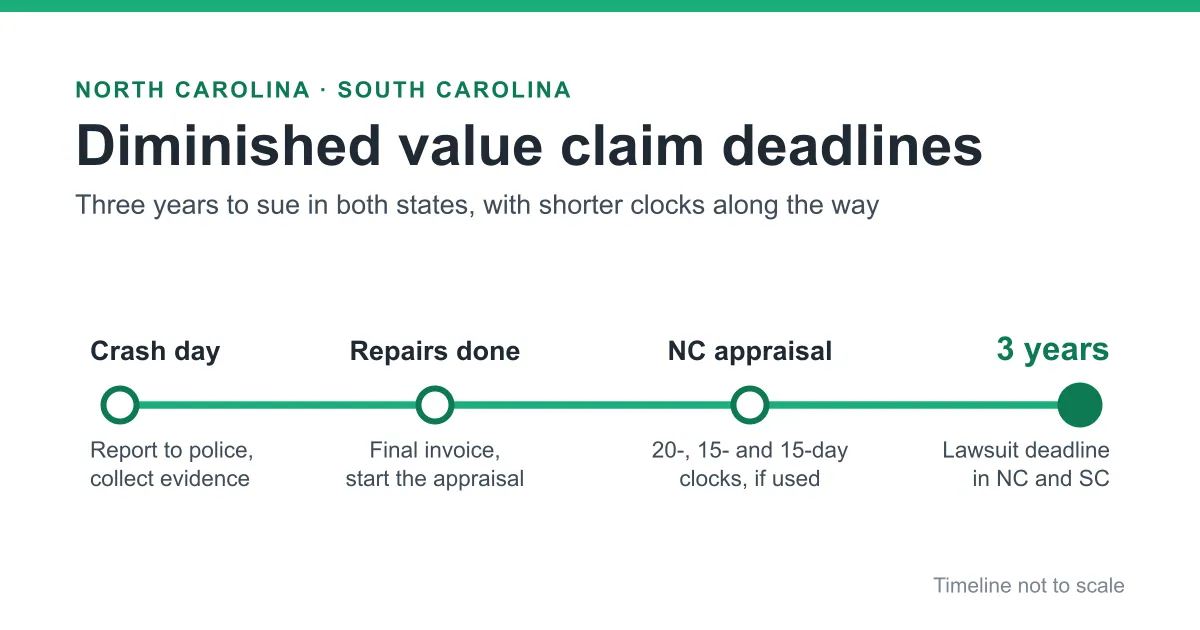
North Carolina also requires drivers to notify the insurance carrier of a diminished value claim within 30 days of repairs being completed. Missing that window can create additional barriers. Once notified, you generally have three years from the date of the accident to pursue the claim. Understanding these timelines, combined with the fault rules, shapes your entire strategy from day one. See our overview of diminished value claims in North Carolina for a full breakdown of the process.
Why an Independent Appraisal Matters More in a Contributory Negligence State
In a state where one percent of perceived fault can end your claim, the strength of your evidence is not a nice-to-have. It is everything. Insurers know that a weak claim is easier to challenge on liability grounds. A claim backed by a professionally prepared independent appraisal, with market comparables, vehicle history documentation, and a methodologically defensible valuation, is significantly harder to deflect with fault arguments.
What a Strong Appraisal Package Should Include
- Pre-accident value documentation using market data and comparable sales, not just a price guide
- Post-repair market analysis showing what buyers actually pay for accident-history vehicles vs. clean examples
- Written dealer trade-in offers after repairs are complete
- Vehicle history report confirming the accident entry and its market impact
- Repair documentation including parts invoices, scan reports, and paint thickness readings
- Photographic record of damage before and after repairs
When an insurer tries to use contributory negligence to deflect your claim, a thorough appraisal does not resolve the fault question directly, but it does establish the credibility of your position. It signals that you have done the work and you are prepared to escalate if necessary. If the insurer invokes the appraisal clause under North Carolina General Statute § 20-279.21, both sides appoint independent appraisers, and if they cannot agree, an umpire decides. That process rewards preparation. You can learn more about what documentation is necessary in our guide on proving your diminished value claim in the Carolinas.
Steps to Protect Your Claim From Day One
The decisions you make in the hours and days after an accident directly affect whether contributory negligence becomes a usable defense against you. Here is how to protect your position:
1. Say as little as possible at the scene
Anything interpreted as an admission, even a casual “I’m sorry,” can be used later to argue contributory fault. Stick to exchanging insurance and contact information. Do not offer assessments of what happened or who may have caused the accident.
2. Do not give a recorded statement without preparation
Insurance adjusters use recorded statements to look for inconsistencies or phrasing that implies shared fault. You are generally not required to give a recorded statement to the other driver’s insurer. If you do, prepare carefully and stick to the facts you can state with confidence.
3. Gather evidence that establishes fault clearly
Police reports, witness names and contact information, dashcam footage, traffic camera records, and photos of the scene all help build a clear liability record. The stronger your fault evidence, the less room an insurer has to raise contributory negligence as a credible defense.
4. Notify the insurer of your diminished value intent within 30 days of repairs
This is a North Carolina-specific deadline that many drivers miss. Failing to notify within 30 days of completed repairs can jeopardize your right to pursue the claim. Put the notification in writing and keep a record. Our diminished value guide for Carolina drivers walks through the notification process and what to include in your initial demand.
5. Get an independent appraisal before you accept any settlement offer
Insurers routinely use internal formulas that produce lowball valuations. An independent appraisal based on market data gives you a defensible number and changes the negotiation dynamic. Once you accept a settlement and sign a release, the claim is closed regardless of what a later appraisal might have recovered.
Free Quote for Carolina Drivers
Your Accident Was Not Your Fault. Do Not Let a Legal Technicality Erase Your Recovery.
North Carolina’s contributory negligence rule is one of the harshest in the country. An independent diminished value appraisal from Diminished Value Carolina gives you documented, market-based evidence that is far more difficult to dismiss than an unsupported demand. Get your free quote today and find out what your vehicle’s lost value is actually worth. Get Your Free Diminished Value Quote
Download This Guide as a PDF
Save a copy of this guide on NC’s contributory negligence rule and how it affects your diminished value claim. Includes the fault rule breakdown, exception doctrine, claim timeline, and documentation checklist.Download the Free PDF →
Frequently Asked Questions
Can I file a diminished value claim in North Carolina if I was partially at fault?
Under North Carolina’s pure contributory negligence rule, if you are found to share any portion of fault for the accident, you are generally barred from recovering damages from the at-fault driver’s insurance, including diminished value. The only meaningful exception is the Last Clear Chance Doctrine, which requires showing the other driver had the final opportunity to prevent the collision and failed to act. If you believe this exception may apply to your situation, it is worth exploring with a professional before assuming your claim is unrecoverable.
What is the deadline to file a diminished value claim in North Carolina?
North Carolina has a unique two-step deadline. You must notify the at-fault driver’s insurance carrier of your intent to pursue a diminished value claim within 30 days of repairs being completed. After that notification, you have up to three years from the date of the accident to formally pursue the claim. Missing the 30-day notification window can create barriers that may limit your ability to recover anything at all.
Will my own insurance cover diminished value in North Carolina?
Standard first-party collision policies in North Carolina typically exclude diminished value coverage. Your own insurance will generally cover repair costs but not the resulting loss in resale value. If the at-fault driver is uninsured and identified, you may be able to pursue diminished value under your own uninsured motorist property damage coverage, subject to your policy terms. Hit-and-run situations where the other driver cannot be identified are generally not covered under this path.
How do insurance companies use contributory negligence to deny diminished value claims?
Insurers typically look for any statement, recorded or otherwise, that suggests you played a role in causing or worsening the accident. They may point to following distance, speed, lane position, or even delayed reaction as evidence of shared fault. Because the standard in North Carolina is only one percent of fault to bar recovery, they do not need to make a strong case. Any plausible argument can be used as leverage to deny the claim or pressure a lowball settlement. Thorough documentation of the scene, a clear police report, and a professional appraisal all make it harder for insurers to sustain these arguments.
Does North Carolina’s damage disclosure law affect my diminished value claim?
Yes, and it works in your favor when it comes to establishing loss. North Carolina law requires sellers of vehicles less than five years old to disclose in writing any damage exceeding 25 percent of fair market value. The vehicle title itself includes a section asking about accident history. These disclosure requirements create a direct, documented link between accident history and reduced resale appeal, which strengthens the market-based case for your diminished value claim. If a buyer cannot buy your vehicle without being informed of the accident, the financial impact on what they will pay is real and measurable.