
After a collision, most drivers focus on the visible damage and the repair estimate. What gets missed almost every time is a second financial loss that does not show up in any repair bill: the drop in your vehicle’s market value caused by its accident history. That loss is called diminished value, and in North Carolina and South Carolina, whether you can actually recover it depends on one question that most drivers never think to ask: who was at fault?
Fault Is Not Just an Insurance Formality
Most drivers treat fault as a background detail. The adjuster assigns it, the claim moves forward, and life continues. But in the context of a diminished value claim, fault is the legal foundation that determines what you can pursue and from whom.
When another driver causes the accident, you have what is called a third-party claim. You file against their liability insurance, which covers property damage and, in most cases, diminished value. When you are the at-fault driver, you are limited to your own first-party coverage, which typically means collision insurance. Collision insurance, in the vast majority of policies, does not cover diminished value.
That single distinction eliminates a legitimate financial recovery for thousands of Carolina drivers every year, not because the law says no, but because they never knew to ask the question.
NC and SC Play by Different Rules
North Carolina and South Carolina share a border, but they operate under fundamentally different legal standards when fault is disputed after an auto accident. Knowing which state you are in is not optional. It changes your entire strategy.
North Carolina: Contributory Negligence
North Carolina follows the doctrine of contributory negligence, one of the harshest fault standards still in use in the United States. Under this rule, if you contributed to the accident in any way, even a small degree, you may be completely barred from recovering anything from the other driver’s insurance. That includes diminished value.
In practical terms, a driver who was 5% responsible for a collision could walk away with nothing from a third-party claim, while the driver who was 95% responsible pays nothing toward your vehicle’s lost market value. North Carolina courts have upheld this standard consistently, and insurers know it well.
If you are filing a diminished value claim in North Carolina, you need to be confident that no fault was assigned to you before moving forward. If fault is disputed, that dispute needs to be resolved first.
South Carolina: Modified Comparative Fault
South Carolina uses a modified comparative fault system, which is more forgiving but still consequential. Under this approach, your ability to recover depends on your share of fault. As long as you were less than 51% responsible for the accident, you can file a claim against the at-fault driver. Your recovery is reduced proportionally to your assigned fault percentage.
If your vehicle suffered $6,000 in diminished value and you were found 20% at fault, you could potentially recover $4,800. You do not lose the entire claim simply because you share some responsibility. But that reduction is real money, and it gives insurers a strong incentive to argue that your fault percentage was higher than it actually was.
Filing a DV Claim When You Were Not at Fault
If the other driver was fully at fault, your path to a diminished value claim is the clearest it will ever be. You file a third-party property damage claim against their liability coverage. Diminished value is a recognized component of property damage in both states, and their insurer is responsible for compensating you for the market value your car has lost.
That said, a clear fault assignment does not mean an automatic or fair payment. Insurers routinely minimize or deny diminished value claims. They may argue the repair quality was sufficient to eliminate any meaningful loss in value, use the widely discredited 17c formula to generate a suspiciously low number, or simply wait to see if you accept the first offer without pushing back.
A professional appraisal gives your claim a defensible dollar figure. Without one, you are negotiating on the insurer’s terms, using their math, and accepting their framing of what your loss is worth.
To put yourself in the strongest possible position, gather the accident report confirming the other driver’s fault, complete repair records, and a professional appraisal documenting the market value loss. Understanding how to prove and maximize a diminished value claim before you engage with the adjuster makes a measurable difference in the outcome.
What Happens When You Are the At-Fault Driver
If you caused the accident, your recovery options shrink considerably. Your collision coverage handles the physical repairs, but it does not compensate you for the drop in your vehicle’s resale value. That loss belongs to you.
There is a narrow exception worth checking: a small number of policies include a first-party diminished value provision. These are uncommon, but they exist. Review your policy language carefully or call your carrier and ask directly. If it is not written into your coverage, assume it is not there.
The harder reality for at-fault drivers in both states is that the accident history follows the vehicle regardless of who was responsible. Vehicle history reports like Carfax and AutoCheck flag accident involvement without regard to fault. When you go to sell that car, buyers will see it, and they will negotiate accordingly. The market does not care who was at fault. It only cares that the car was in an accident.
The Gray Areas: Shared Fault, Uninsured Drivers, and Hit-and-Runs
Not every accident produces a clean, uncontested fault determination. Here is how the most common gray-area scenarios play out for Carolina drivers pursuing a diminished value claim:
| Scenario | NC Outcome | SC Outcome |
|---|---|---|
| You were 10% at fault | Claim likely barred entirely | Recovery reduced by 10% |
| You were 50% at fault | Claim likely barred entirely | Recovery reduced by 50% |
| Hit-and-run, driver unknown | UM coverage may apply; DV rarely included | UM coverage may apply; DV rarely included |
| At-fault driver uninsured | File under your UM/UIM coverage | File under your UM/UIM coverage |
| Fault contested between parties | Must establish clear innocence to preserve claim | Partial recovery possible if under 51% fault |
Uninsured and underinsured motorist coverage is where many Carolina drivers end up when the at-fault driver has no insurance. Most UM policies do not explicitly cover diminished value, but some carriers have paid out on these claims when the policyholder pushed back on the initial denial. It depends heavily on the specific policy language and how the claim is framed.
If you are unsure where your situation falls, the diminished value calculator gives you a working baseline before you decide how to proceed.
The Appraisal Is What Puts Real Numbers on the Table
One thing most drivers overlook: the insurer’s fault determination is their internal assessment, not a court ruling. If you believe fault was assigned incorrectly, you have the right to dispute it. A police report, witness statements, or an independent accident reconstruction can all support a different conclusion.
But regardless of how fault is resolved, the appraisal is what establishes the actual dollar value of your loss. Without an independent professional assessment, you have no credible number to put in front of the adjuster. The insurer will apply their own methodology, and it will almost always produce a figure well below the real market impact.
For trucks, SUVs, luxury vehicles, and cars with low mileage, the gap between what the insurer offers and what the market actually penalizes can be significant. Understanding how a car accident affects your vehicle’s resale value puts that number in real terms before the conversation with the adjuster even starts.
Not Sure If Your Situation Qualifies? Find Out for Free.
Whether fault is clear or still being disputed, a free quote tells you exactly what your vehicle’s loss in value is worth. No commitment. No guesswork. Get Your Free Loss in Value Quote
Want to save this for reference? Download the PDF version of this article below.
Frequently Asked Questions
Can I file a diminished value claim if I was partially at fault in North Carolina?
It is very difficult. North Carolina follows contributory negligence, which means that even a minor degree of fault on your part can bar you from recovering damages from the other driver’s insurance. If any fault was assigned to you, consult with an attorney before filing a claim.
What if I was not at fault but the other driver had no insurance?
You would need to file under your own uninsured motorist coverage. Whether UM coverage includes diminished value depends on your specific policy language. Some carriers have paid these claims when pushed, but it is not a guaranteed outcome and often requires disputing an initial denial.
Does shared fault reduce my diminished value recovery in South Carolina?
Yes. South Carolina uses modified comparative fault, so your recovery is reduced by your percentage of fault. If you were 25% at fault and your documented diminished value is $5,000, you can recover up to $3,750 from the other party’s insurer. The key is having a credible appraisal to support the base figure.
Do I need a professional appraisal to file a diminished value claim?
You are not legally required to have one, but filing without an independent appraisal puts you at a serious disadvantage. The insurer will apply their own valuation methodology, which almost always produces a lower number than the actual market impact. A professional appraisal gives you a defensible figure to negotiate from.
How long do I have to file a diminished value claim in NC or SC?
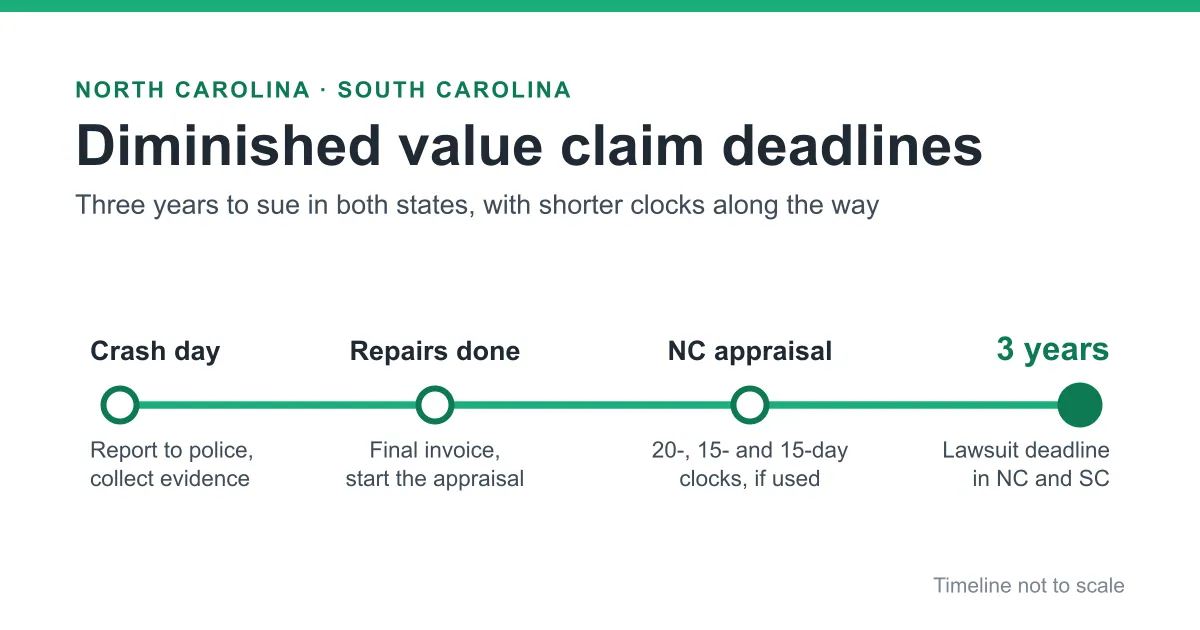
Both North Carolina and South Carolina generally allow three years to file a property damage claim. However, waiting weakens your case. The connection between the accident and the value loss becomes harder to document over time, and the insurer may use the delay against you. Filing as soon as repairs are complete is always the stronger move.