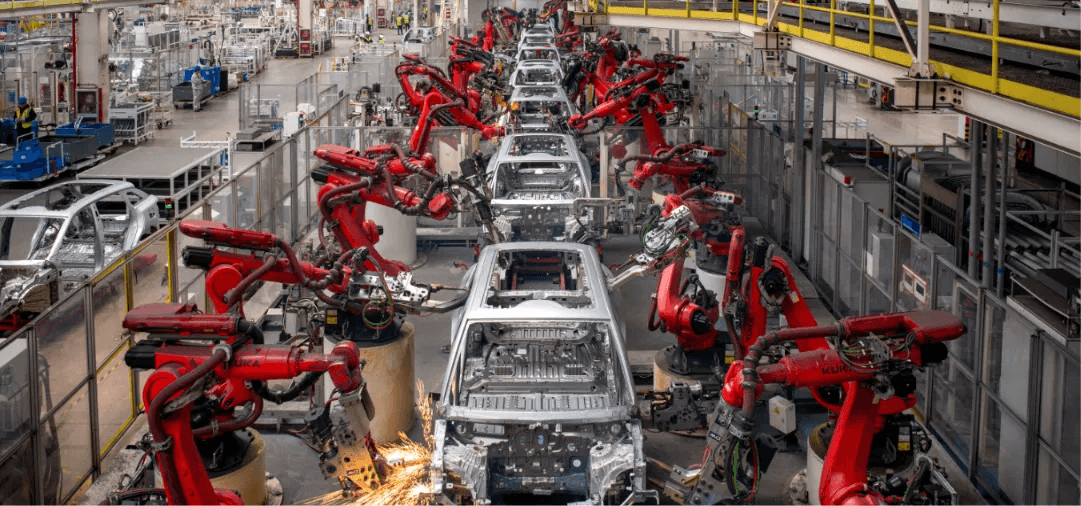

China built more than a third of every car, truck, and bus manufactured on the planet last year. Global vehicle production hit 96.4 million units in 2025, according to the International Organization of Motor Vehicle Manufacturers, and China alone accounted for 34.5 million of them, a 35.8% share of total world output. To put that in perspective, the United States, the world’s second-largest producer, built 10.2 million units, less than a third of China’s total. This is not a gradual shift anymore. It is a structural realignment of where the world’s cars actually come from.
Here is what is driving China’s dominance, how the rest of the world is responding, and what it could mean for car buyers and owners going forward.
The Numbers Behind China’s Lead
Global vehicle production climbed from 92.7 million units in 2024 to 96.4 million in 2025, a 3.9% increase, according to OICA’s most recent industry report. But that growth was not distributed evenly. Asia-Pacific production rose 7.6% to roughly 59.2 million vehicles, pushing the region’s share of global output above 61%. China drove most of that gain on its own, adding 3.25 million vehicles in a single year to reach its 34.5 million total, up 10% from 2024.
The rest of the top five global producers are not close. Japan came in third with 8.4 million units, India fourth with 6.5 million, and Germany fifth with 4.2 million. Combined, the next four largest producers after China do not add up to China’s total on their own.
| Country | 2025 Production | Year-over-Year Change |
|---|---|---|
| China | 34.5 million units | +10% |
| United States | 10.2 million units | -3% |
| Japan | 8.4 million units | +2% |
| India | 6.5 million units | +8% |
| Germany | 4.2 million units | +2% |
China produced more vehicles in 2025 than the United States, Japan, India, and Germany combined. A decade ago, that gap would have seemed implausible.
Why the Domestic Chinese Market Alone Does Not Explain This
Here is the part that makes this story more interesting than a simple production statistic. China’s domestic auto market has actually struggled in 2026. Passenger car retail sales fell sharply in the first months of the year, and an intense price war among domestic manufacturers has squeezed margins across the industry. If China’s growth were purely about selling more cars to Chinese consumers, this would be a very different story.
Instead, the growth engine has shifted almost entirely to exports. China closed 2025 with a record 7.1 million vehicle exports, and that pace accelerated further into 2026. By May, exports reached approximately 930,000 units in a single month, up 68.7% year over year, and now account for more than 35% of China’s total vehicle shipments. Industry analysts describe this as a “strong exports, weak domestic” bifurcation that has become the defining feature of China’s auto industry this year, with a full-year export figure approaching 10 million units now considered a baseline scenario rather than an ambitious target.
China’s auto industry has quietly transformed from a domestic growth story into an export-driven one. Chinese manufacturers are increasingly building for the world, not just for Chinese buyers.
BYD and the New Export Playbook
BYD is the clearest example of how quickly this shift has moved. In the first half of 2026, 43% of BYD’s total vehicle sales came from markets outside China, up sharply from the prior year. The company exported 175,300 new energy vehicles in June alone, a 95% increase year over year, and its overseas sales for the first half of 2026 topped 1.8 million vehicles combined with domestic sales. Meanwhile, BYD’s domestic China sales actually fell nearly 40% in the first half of the year under the pressure of the price war, while exports grew more than 70% and now generate far higher margins than domestic sales.
BYD is not simply shipping finished cars overseas and hoping tariffs do not bite. The company operates a factory in Thailand that supplies right-hand-drive markets across Southeast Asia and Oceania, and it is building a manufacturing complex in Brazil to serve Latin America from inside Mercosur trade agreements. In Europe, BYD is constructing a plant in Hungary specifically to sidestep EU tariffs on Chinese-made electric vehicles. This localized production model lets BYD compete in major markets without the full weight of import tariffs applied to vehicles built in China.
BYD is not alone. Chery remains China’s largest exporter by volume, with January-through-May exports reaching 752,755 units, up nearly 70% year over year. Geely, SAIC, Chang’an, and Great Wall Motor have each surpassed 50,000 monthly export units, a threshold that industry analysts now describe as table stakes rather than a milestone.
Electrification Is the Structural Advantage, Not Just a Policy Trend
China’s dominance is not only about volume. It is increasingly about a technology advantage that took root years before most global manufacturers took electrification seriously. According to the International Energy Agency, roughly 70% of electric cars sold worldwide as of late 2025 were manufactured in China. New energy vehicles, which include both battery electric and plug-in hybrid models, now account for nearly 57% of China’s total vehicle shipments and more than 60% of passenger vehicle sales.
China also controls a dominant position across the battery supply chain itself, including the mining and processing of critical minerals used in EV batteries. That vertical integration, controlling everything from raw materials to finished vehicles, is difficult for competitors to replicate quickly, and it is a major reason Chinese automakers can develop new vehicles 25% to 30% faster and at 20% to 30% lower cost than established Western manufacturers, according to analysis from Roland Berger.
How the Rest of the World Is Responding
The trade relationship between the United States and China over automotive tariffs has been contentious for most of the past two years, with tariffs and reciprocal tariffs shaping strategy on both sides. China has also used export controls on rare earths and critical minerals as leverage in broader trade negotiations. As of early 2026, something closer to an industrial truce appears to be holding, though the underlying competitive pressure has not eased.
In markets where tariffs on China-made vehicles are steep, Chinese automakers are increasingly building locally instead of exporting finished vehicles, exactly as BYD is doing in Hungary and Brazil. This approach turns tariff barriers into a manufacturing decision rather than a sales barrier, and it means the “China effect” on global car markets is not limited to vehicles physically built in China. It increasingly includes vehicles built by Chinese companies anywhere in the world.
Traditional automakers are not standing still, but the scale of the challenge is significant. Chinese brands are already gaining real traction in markets long dominated by Japanese, German, and American manufacturers. The Jaecoo 7, built by Chery, was the best-selling new car in the United Kingdom in March 2026, a genuinely striking data point for a brand that barely existed in Western Europe a few years earlier.
What This Means Going Forward
China’s rise to more than a third of global vehicle production is not a temporary capacity overhang working itself out. It reflects a deliberate, well-executed industrial strategy built on electrification, vertical integration of the battery supply chain, faster product development cycles, and an aggressive export push into markets around the world, increasingly through local manufacturing rather than direct exports.
For the global auto industry, the practical result is a more fragmented, more competitive landscape than existed even five years ago. Production is concentrating in Asia while European output stagnates and American manufacturers navigate a more uncertain trade and policy environment. Whatever happens next in the ongoing tariff negotiations between major economies, the underlying shift in where the world’s vehicles are actually built has already happened. The question now is how quickly everyone else adapts to compete inside that new reality.
Not Sure What Your Vehicle Is Worth in Today’s Market?
Get a free, no-obligation quote from the Carolinas’ most trusted diminished value appraisers, backed by real market data. Get Your Free QuoteRead the Full Article Online
Want to keep this analysis on hand? Download the PDF version of this article
Frequently Asked Questions
Does China really produce more than a third of the world’s vehicles?
Yes. According to OICA data, China produced 34.5 million vehicles in 2025 out of a global total of 96.4 million, a 35.8% share. That is more than the next four largest producing countries, the United States, Japan, India, and Germany, combined.
Is China’s growth driven by strong domestic car sales?
Not primarily. China’s domestic passenger car market has actually softened in 2026 due to an intense price war and declining subsidies. The growth is coming overwhelmingly from exports, which reached a record 7.1 million units in 2025 and now account for more than one-third of China’s total vehicle shipments.
How is BYD getting around tariffs on Chinese-made vehicles?
BYD is building factories in the markets it wants to sell into, including an operating plant in Thailand and new facilities under construction in Brazil and Hungary. Vehicles assembled locally in those countries avoid many of the tariffs and logistics costs applied to vehicles exported directly from China.
Why is China’s electric vehicle production so much larger than everyone else’s?
China controls a dominant share of the global EV battery supply chain, including the mining and processing of critical minerals, and roughly 70% of electric cars sold worldwide as of late 2025 were manufactured there. That vertical integration lets Chinese manufacturers develop new vehicles significantly faster and at lower cost than most Western competitors.
Will Chinese-made cars become common in the United States?
Direct imports of Chinese-made vehicles face significant tariff barriers in the United States, unlike in markets such as Europe, Latin America, and Southeast Asia. However, the broader competitive pressure from Chinese manufacturers, particularly on price and EV technology, is already influencing strategy at American and other global automakers regardless of direct market access.