
Key takeaways
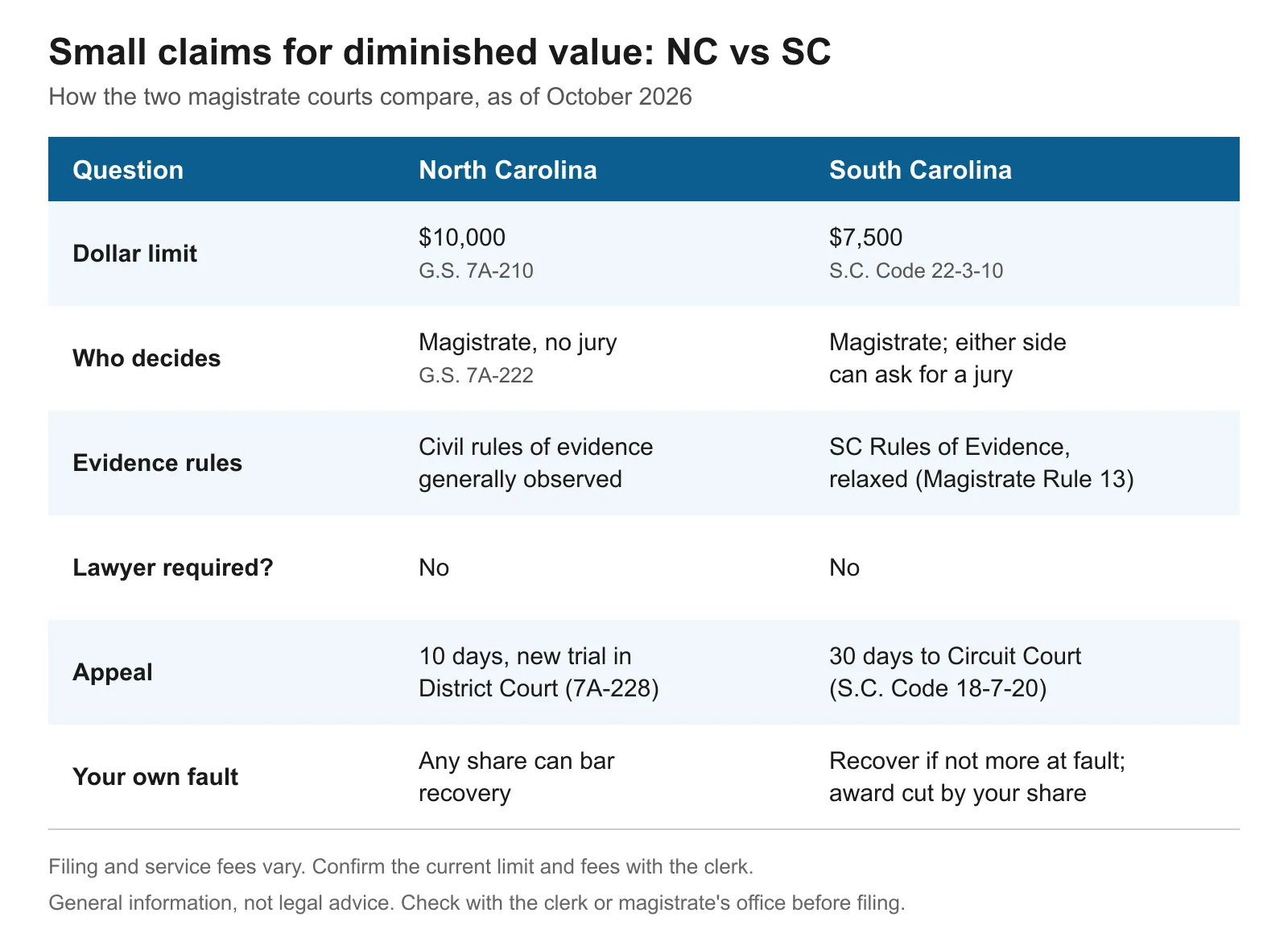
- North Carolina small claims court hears cases up to $10,000 (G.S. 7A-210). South Carolina magistrate court hears cases up to $7,500 (S.C. Code § 22-3-10).
- In both states you generally sue the at-fault driver, not the driver's insurance company. The insurer usually steps in to defend its driver.
- Neither court requires a lawyer. North Carolina magistrates apply the regular civil rules of evidence, so a written appraisal on its own may draw a hearsay objection.
- Fault works differently. In North Carolina, any share of fault can bar your claim. In South Carolina, the award is cut by your share, and you recover nothing if you were more at fault than the other driver.
- A losing side can appeal within 10 days in North Carolina (G.S. 7A-228) or 30 days in South Carolina (S.C. Code § 18-7-20).
Yes, you can use small claims court for diminished value in both Carolinas. North Carolina small claims court hears claims up to $10,000, and South Carolina magistrate court hears claims up to $7,500. You usually sue the at-fault driver, not the insurer. No lawyer is required, but plan how your appraiser's opinion will reach the magistrate.
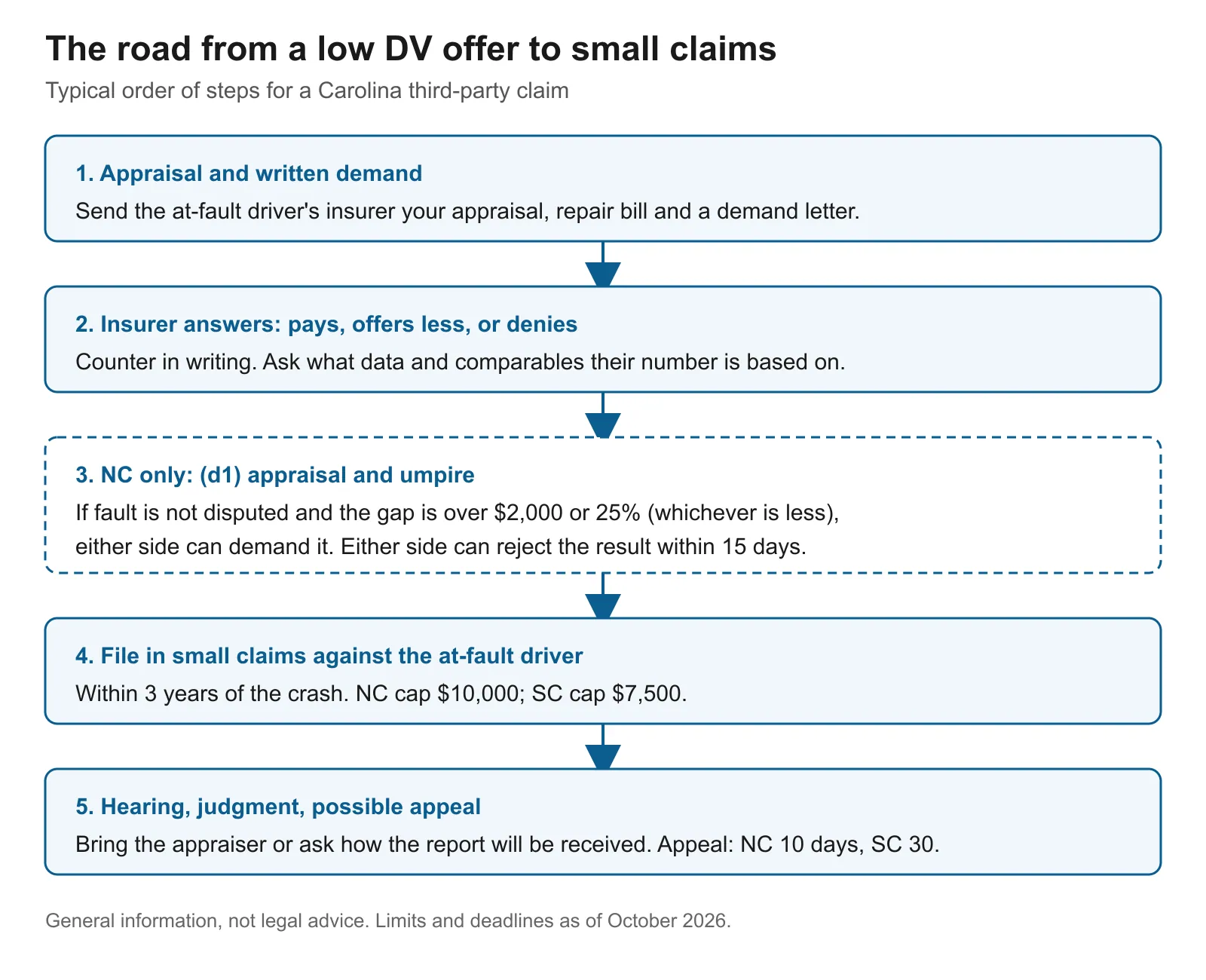
Small claims court for diminished value is usually the last step, after a written demand, a counteroffer and, in North Carolina, possibly the statutory appraisal process. This guide covers when it makes sense, whom to sue, what to bring and how the two states differ.
We are auto appraisers, not attorneys, and this is general information, not legal advice. Court rules change, so confirm limits, fees and procedures with the clerk or magistrate's office before you file.
When does small claims court make sense for a diminished value claim?
Small claims court makes sense once the at-fault driver's insurer has denied your diminished value claim or made an offer that's well below your appraisal, and written negotiation has stalled. It also needs to be a claim the court can hear: the amount must fit under the state's limit, and you must file within three years of the crash.
Before you file, you should already have:
- A diminished value appraisal based on the final repair bill.
- A written demand sent to the insurer, with the appraisal attached.
- The insurer's written reply, whether that's an offer or a denial.
- A record of your counteroffer and any follow-up.
If you're still at the denial stage, read how to respond when a diminished value claim is denied first. A detailed written reply sometimes resolves the claim without a lawsuit.
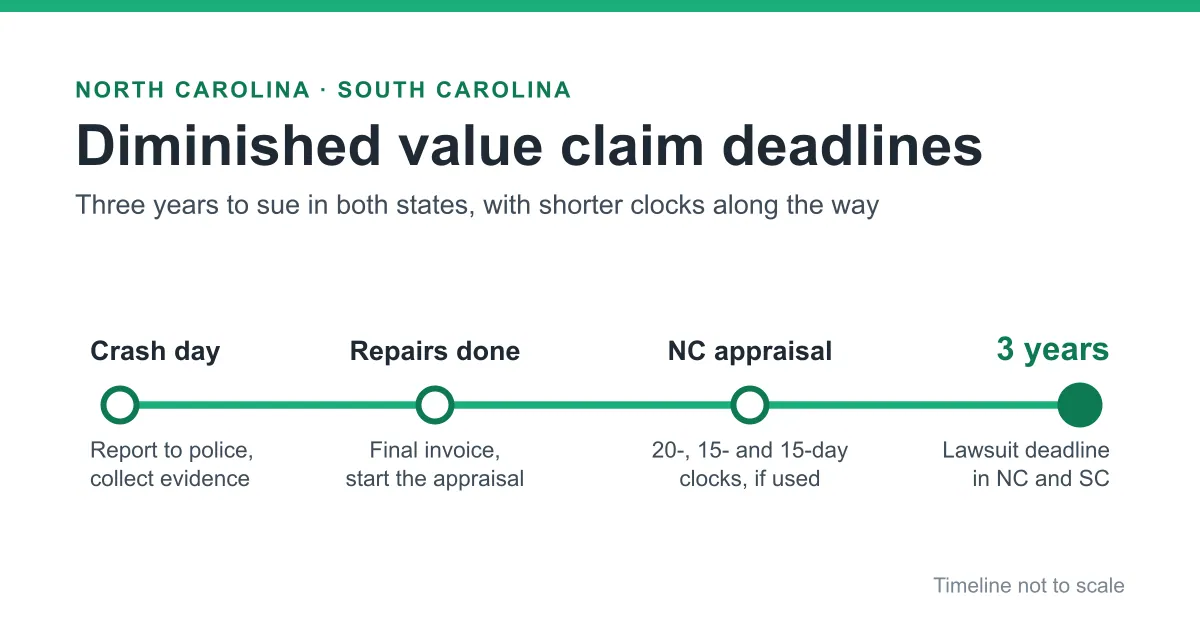
Timing matters too. Both states give you three years to sue over vehicle damage, and negotiating with an adjuster doesn't pause that clock. Our guide to diminished value claim deadlines in NC and SC explains when the three years start.
How much can you sue for in NC and SC small claims court?
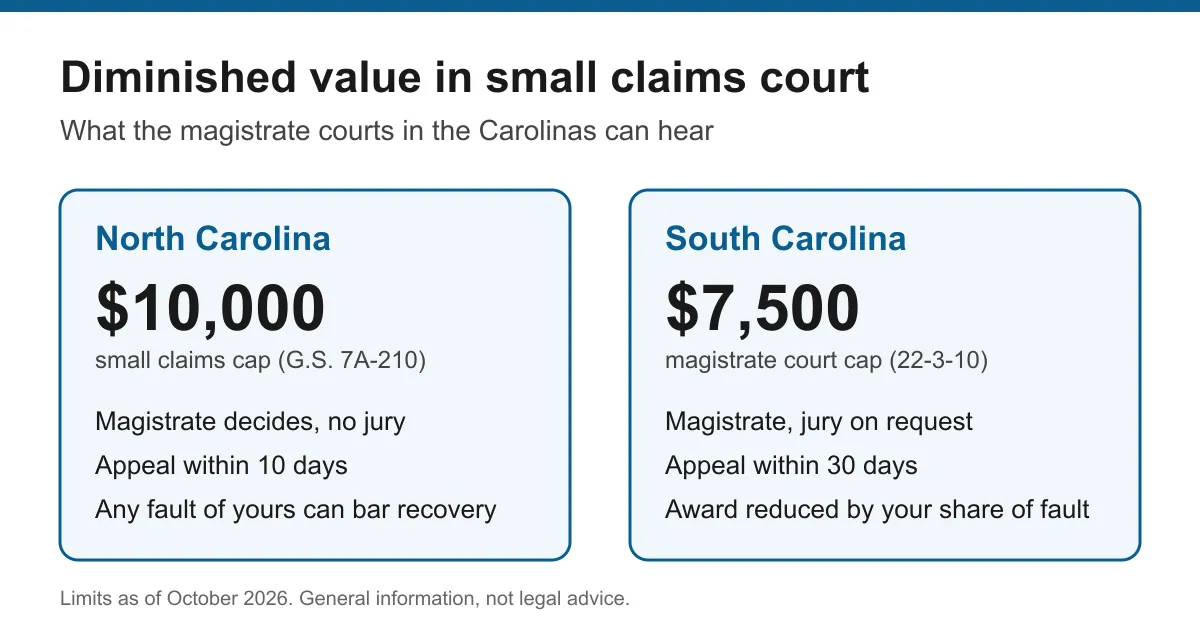
North Carolina small claims court hears money claims up to $10,000 (G.S. 7A-210). South Carolina magistrate court hears damage claims up to $7,500 (S.C. Code § 22-3-10). Those caps are the total you can ask for in that court, not just the diminished value piece.
North Carolina
The $10,000 cap covers most diminished value claims on everyday cars. If your appraisal comes in higher, the case belongs in district court, which is more formal. Some people limit their demand to the cap to stay in small claims. That means giving up the rest of the claim for good, so talk to an attorney before you do it.
South Carolina
The $7,500 limit has stayed the same since 2004. A 2025 Senate bill, S.251, would raise it to $15,000, but as of October 2026 it hadn't moved out of committee. On a newer truck, SUV or luxury car, diminished value plus other property losses can pass $7,500, which pushes the case into circuit court.
What counts toward the total? Diminished value is the main item. Other property damage losses, such as unpaid repair costs or loss of use, may be part of the same claim. Whether the court will also award your appraisal fee is up to the magistrate, so don't count on it.
Who do you sue for diminished value in the Carolinas?
In North and South Carolina you generally sue the at-fault driver, not the driver's insurance company. Both states follow the long-standing rule that an injured person can't sue the at-fault driver's liability insurer directly for the driver's negligence. If the at-fault driver didn't own the car, the owner may also be named.
In practice, the insurer still handles the case. Once its driver is served, the insurer usually sends an adjuster or hires a lawyer to defend the suit, and it pays any judgment up to the policy's property damage limit. Many people are uneasy about suing a person rather than a company. The insurer is still the one paying, because that's what the driver bought the coverage for.
Claims against your own insurer, such as uninsured motorist claims after a hit-and-run, follow different rules. Those depend on your policy and on state law, and North Carolina limits first-party diminished value. Ask an attorney before suing your own carrier.
How does fault change your case in each state?
The two Carolinas treat your own share of fault very differently, and the at-fault driver's side can raise it as a defense at the hearing.
North Carolina
North Carolina follows contributory negligence. If the magistrate finds you were even slightly at fault, you can be barred from recovering anything, with narrow exceptions such as "last clear chance." Our guide to North Carolina's contributory negligence rule and your DV claim covers how insurers use it. If the other side argues you were partly at fault, bring the crash report, photos and any witness.
South Carolina
South Carolina uses modified comparative fault. You can recover as long as your fault isn't greater than the other driver's, and the award is cut by your share. If you were 20% at fault for a $5,000 loss, you'd recover $4,000. At 51% or more, you recover nothing.
Not sure what your car lost in value?
Get a free diminished value review from a licensed Carolina appraiser before you decide whether a lawsuit is worth it. Get Your Free Quote
Should you use North Carolina's appraisal and umpire process first?
North Carolina offers a path that South Carolina doesn't: the appraisal and umpire process in G.S. 20-279.21(d1). It applies when liability isn't disputed and you and the insurer are more than $2,000 or 25% of the car's pre-accident retail value apart, whichever is less. Either side can start it with a written demand.
Each side names an appraiser, and if the two can't agree, an umpire decides. Either party can reject the result within 15 days. If nobody rejects it, it becomes binding, and small claims court is off the table. Each side pays its own appraiser, and the umpire's cost is split.
This process only settles the dollar amount. It doesn't decide fault. When the insurer disputes fault, small claims court (or a higher court) is where that gets decided. Our North Carolina diminished value guide covers how the two paths fit together.
What evidence should you bring to a small claims diminished value hearing?
Bring evidence that proves two things: the other driver caused the crash, and your car is worth less after repair than it was before. The magistrate decides from what's in front of them on the hearing date, so bring everything and make copies for the other side.
A practical checklist:
- Your diminished value appraisal report, with the appraiser's license and qualifications.
- The final repair invoice, including every supplement.
- Photos of the damage before repair and the car after repair.
- The police crash report.
- Every letter and email with the insurer, including its offer or denial.
- A vehicle history report showing the accident, if one has been posted.
- Witnesses to the crash, or the appraiser, ready to testify.
Is a written appraisal report enough?
In North Carolina, maybe not on its own. G.S. 7A-222 says magistrates generally observe the regular civil rules of evidence. A report from an appraiser who isn't there to answer questions may draw a hearsay objection. Magistrates often weigh doubtful evidence instead of excluding it, but you can't count on that. In South Carolina, Magistrate Court Rule 13 says the rules of evidence apply but are relaxed in the interest of justice, which gives you more room.
The safest approach in both states is to have the appraiser available to testify. A USPAP-compliant report from a licensed appraiser explains how the before and after values were reached, and the appraiser can answer the magistrate's questions about comparables and repair quality. Diminished Value Carolina prepares independent diminished value appraisals for North and South Carolina drivers. You can order a diminished value appraisal online.
How do you file and what happens at the hearing?
You file a small claims complaint with the court in the county where the defendant lives, pay the filing fee and arrange service on the defendant.
North Carolina
File with the Clerk of Superior Court in the defendant's county of residence. The clerk's office has the complaint form, and the sheriff can serve it. Filing and service fees are set statewide and posted on the NC Judicial Branch court costs page. A magistrate hears the case without a jury. At the end of the hearing, the magistrate can rule on the spot or take up to 10 days to decide.
South Carolina
File a summons and complaint at the magistrate's office in the right county. Fees vary by county. Jasper and Kershaw counties, for example, list $80 for a summons and complaint. The defendant has 30 days to answer. Either side can ask for a jury trial, and the magistrate is expected to question unrepresented parties to bring out the facts.
What happens after a small claims judgment?
If you win, the judgment says how much the defendant owes. When the at-fault driver is insured, payment usually comes from the insurer, up to the property damage limit. Payment isn't automatic, though. If it doesn't arrive, the clerk's office can explain how to enforce the judgment.
Either side can appeal. In North Carolina, the losing party has 10 days to appeal to district court, where the case is heard again from the start, with a jury if one is requested (G.S. 7A-228). In South Carolina, notice of appeal to circuit court must be served within 30 days after written notice of the judgment, or from the date it was announced in court (S.C. Code § 18-7-20). Keep your evidence together after the hearing in case the other side appeals.
See what your claim is worth before you file
A free claim review shows whether your diminished value is large enough to justify a lawsuit and which court it would belong in. Get Your Free Quote
Frequently asked questions
Can I sue for diminished value in small claims court in North Carolina?
Yes. A diminished value claim against the at-fault driver is a property damage claim, and North Carolina small claims court hears money claims up to $10,000 (G.S. 7A-210). A magistrate decides the case without a jury. You file with the Clerk of Superior Court in the county where the defendant lives, and you have three years from the crash to file.
What is the small claims limit in South Carolina for a car damage claim?
South Carolina magistrate court hears damage claims up to $7,500 (S.C. Code § 22-3-10). If your diminished value and other property losses add up to more than that, the case belongs in circuit court, which is more formal. Bills to raise the limit were introduced in 2025, but as of October 2026 none had passed.
Do I sue the insurance company or the driver for diminished value?
In North and South Carolina you generally sue the at-fault driver, plus the vehicle's owner if that's someone else, not the liability insurer. The insurer usually hires a lawyer or sends an adjuster to defend its driver and pays any judgment up to the policy limits. If you aren't sure whom to name, ask the clerk's office or an attorney before you file.
Will a magistrate accept my diminished value appraisal report?
Maybe not on its own. North Carolina magistrates generally follow the civil rules of evidence, and a written report from someone who isn't in the room can draw a hearsay objection. South Carolina magistrates apply the evidence rules more loosely under Magistrate Rule 13. The safest plan is to have the appraiser available to testify, in person or as the court allows.
How do I appeal a small claims judgment in the Carolinas?
In North Carolina, either side can appeal to district court within 10 days of the judgment, and the case is heard again from the start (G.S. 7A-228). In South Carolina, the appeal goes to circuit court, and notice must be served within 30 days after written notice of the judgment (S.C. Code § 18-7-20). Appeal fees apply in both states.
Sources
- N.C. Gen. Stat. Chapter 7A, Article 19 (small claims, §§ 7A-210 to 7A-232), official text
- S.C. Code Title 22, Chapter 3 (magistrates' civil jurisdiction, § 22-3-10), official text
- S.C. Code Title 18, Chapter 7 (appeals from magistrates, § 18-7-20), official text
- South Carolina S.251 (2025-2026), bill to raise magistrate civil jurisdiction to $15,000, status
- NC Judicial Branch, current court costs