
If your car was financed when it got hit, you probably assumed the diminished value conversation was between you and the insurance company. It isn’t quite that simple. The bank that holds your loan has a legal stake in that settlement too, and if you don’t understand how that plays out, you can end up confused about why a check showed up with someone else’s name on it, or worse, why you’re still making payments on a car that’s worth thousands less than it used to be.
This is one of the most misunderstood parts of the diminished value process in North Carolina and South Carolina. Owning a financed vehicle does not disqualify you from filing a claim. But it does add a layer most drivers never see coming until the check is already in the mail.
Financing Does Not Block You From Filing a Diminished Value Claim
Start with the basic fact that gets lost in the noise: if you’re the registered owner of the vehicle and the loan is current, you are entitled to pursue diminished value in the Carolinas regardless of whether the bank still holds a lien. The lender’s interest is financial, not a veto over your right to file. What changes is how the payout gets distributed once it’s approved.
Both North Carolina and South Carolina treat diminished value as a component of property damage owed by the at-fault driver’s insurer. The lienholder does not need to authorize your claim or sign off before you start the process. They only enter the picture once money is actually changing hands.
Why the Settlement Check Often Has Two Names On It
Here’s where a lot of drivers get caught off guard. When an insurer issues a settlement for vehicle damage, and in some cases for diminished value specifically, they’ll often cut the check jointly to you and the lienholder. This isn’t the insurance company being difficult. It’s standard practice designed to protect the lender’s financial interest in a vehicle they technically still partially own.
The lienholder’s name on the check does not mean they’re entitled to keep the whole payout. It means both parties need to be involved in cashing or depositing it, and depending on your bank’s policies, that can mean an extra signature, an extra form, or a call to your loan servicer before the funds clear.
Practical tip: call your lienholder before the check arrives, not after. Ask what their process is for endorsing a joint settlement check. Some banks turn this around in a day. Others require notarized forms and can hold things up for weeks if you’re not prepared.
Diminished Value vs. Repair Settlements: Two Different Checks
It helps to separate two things that often get conflated. A repair settlement covers the cost of fixing the car and is far more likely to involve the lienholder directly, since it relates to restoring the physical collateral the bank has an interest in. A diminished value settlement compensates you for the drop in resale value after the repairs are done. It’s a separate calculation, often processed at a different point in time, sometimes months after the repair check has already cleared.
In practice, insurers handle these differently depending on internal policy and the size of the payout. Some diminished value checks get issued to the vehicle owner alone, with no lienholder involvement, because the insurer treats it as compensation for the owner’s loss rather than a payment tied to the physical asset. Others include the lienholder as a matter of routine, particularly on larger claims or newer loans with high balances.
| Settlement Type | Typically Includes Lienholder? | Why |
|---|---|---|
| Repair cost settlement | Usually yes | Tied directly to restoring the physical collateral |
| Diminished value settlement | Sometimes | Depends on insurer policy, loan balance, and payout size |
| Total loss settlement | Always | Lienholder is paid first, up to the remaining balance |
You won’t know which category your check falls into until the insurer processes it, which is exactly why it’s worth asking the adjuster directly, early in the claim, whether the diminished value payout will be issued separately and whether the lienholder will be named.
What Happens If You Owe More Than the Car Is Worth
Diminished value claims are separate from total loss situations, but there’s a related scenario worth understanding if your vehicle carries a large loan balance. If the accident is severe enough that the insurer declares a total loss instead of paying for repairs, the math changes completely. In that case, the lienholder is paid first from the settlement, up to whatever you still owe. Only the remainder, if any, comes to you.
If your loan balance is higher than the vehicle’s actual cash value, a common situation on newer vehicles with minimal money down, you’re left owing the difference out of pocket unless you carry gap insurance. This is a different problem than diminished value, but it’s the reason drivers with financed vehicles need to think about both issues at once instead of assuming a single settlement check will make everything even. Our breakdown of how an accident affects your car’s resale value covers how these losses stack even when the vehicle is repaired rather than totaled.
Does the Bank Have Any Say Over Whether You File?
No. The lienholder’s interest is in being repaid, not in whether you pursue a legitimate financial recovery. They have no legal standing to block a diminished value claim, and in the overwhelming majority of cases, they won’t even be aware the claim was filed until a check with their name on it shows up needing an endorsement.
Where lienholders do occasionally get involved is when a vehicle has an unusually high loan balance relative to its value, or when a dispute over settlement amount escalates to the point that legal action becomes necessary. In practice, that’s rare. For the vast majority of financed vehicle owners in the Carolinas, filing a diminished value claim looks exactly the same as it would for someone who owns their car outright: gather your documentation, get an independent appraisal, and file against the at-fault driver’s insurer.
Building a Claim That Holds Up, Financed or Not
The documentation requirements don’t change because your car is financed. What changes is the paperwork trail around the settlement itself. Here’s what you should have in place before you file:
- Accident report confirming the other driver’s fault
- Complete repair order and final invoice from the shop
- Your loan statement showing current balance and lienholder name and contact information
- An independent diminished value appraisal, not a number generated by the insurer’s internal formula
- Confirmation from your lender on how they handle joint settlement checks
That last item is the one financed vehicle owners skip most often, and it’s the one that causes the most delay. Knowing your lender’s process in advance means you’re not scrambling to figure out endorsement requirements while a settlement check sits uncashed. If you haven’t already documented the full picture of what a strong claim needs, our guide on how to prove and maximize a diminished value claim walks through the evidence adjusters actually respond to.
Timing Matters More When a Loan Is Involved
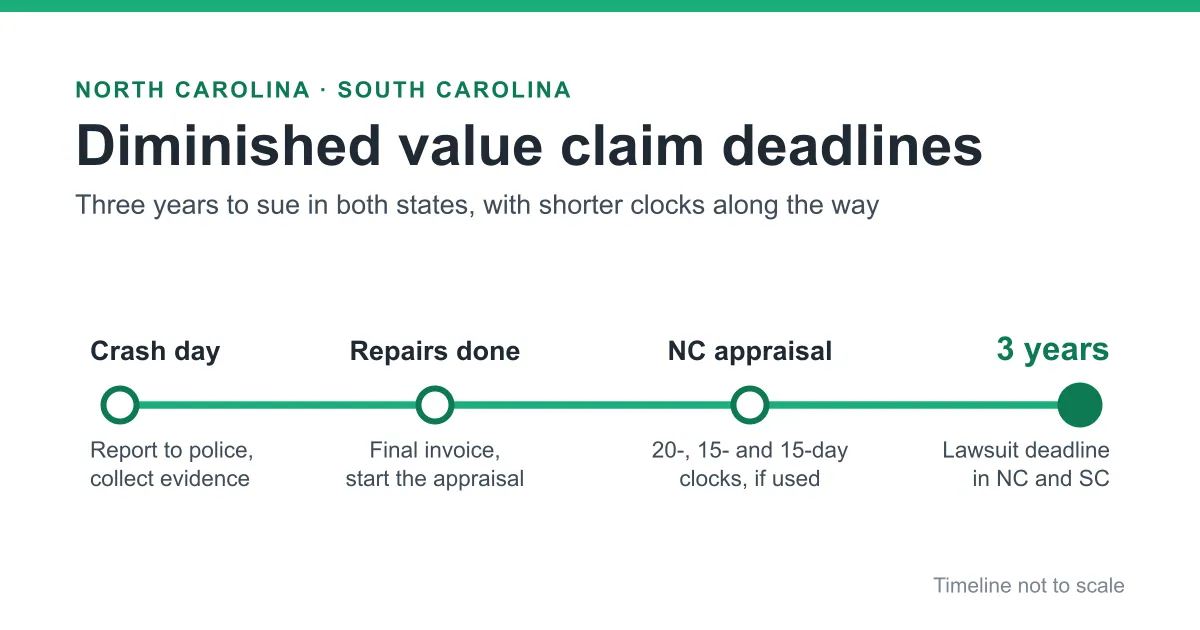
North Carolina gives you three years from the date of the accident to file a property damage claim, and South Carolina applies the same three-year window. That sounds generous, but drivers with an active loan have an added reason not to wait: the longer the loan runs, the more interest accrues on a vehicle that’s already worth less than it was before the crash. Filing your diminished value claim promptly, ideally as soon as repairs are complete, limits how long you’re financing a car at a value the market no longer agrees with.
It also matters for your paper trail. Repair shops don’t keep records indefinitely, and the comparable sales data an appraiser uses to establish your loss becomes harder to pin down the further out you get from the accident date. A claim filed within weeks of the repair is simply easier to support than one filed a year later.
Getting an Appraisal Before You Talk Numbers With Anyone
Whether your car is financed or paid off, the number that actually drives your settlement is the one backed by an independent appraisal, not the figure the insurer’s software spits out. Insurers routinely lean on the 17c formula or similar internal tools that consistently undervalue the real market loss, and that gap matters even more when part of your settlement is earmarked for a lender before it ever reaches you.
Getting a professional appraisal early gives you a defensible number to negotiate with, and it clarifies exactly what portion of any settlement is diminished value versus repair cost, which makes the lienholder conversation a lot easier to navigate.
Financed Vehicle, Diminished Value Claim, Confused About the Check?
Get a free quote and find out exactly what your claim is worth, and how any settlement should be handled with your lender.Get Your Free Quote
Download the Full PDF Guide
Get this article as a complete, printable PDF guide for your records or to share. Download PDF
Frequently Asked Questions
Can I file a diminished value claim if my car is still financed?
Yes. Being the registered owner is what matters, not whether the loan is paid off. The lienholder has a financial interest in the settlement but no authority to block your claim.
Why does the insurance company want to put my lender’s name on the check?
This protects the lender’s collateral interest in the vehicle. It’s standard practice on many settlements, particularly repair costs and total loss payouts, and sometimes applies to diminished value checks as well depending on the insurer.
Do I need my lender’s permission to get an independent appraisal?
No. An independent appraisal is a professional assessment you’re entitled to seek on your own. Your lender has no role in that process. Their involvement starts only when a settlement check needs to be endorsed or deposited.
What happens if my loan balance is more than the settlement amount?
That situation typically arises in total loss claims, not standard diminished value claims. If you owe more than the vehicle’s actual cash value and the car is totaled, you may owe the difference unless you have gap insurance. Diminished value settlements on repaired vehicles work differently and are calculated separately from your loan balance.