
Key takeaways
- North Carolina and South Carolina both give you three years to file a lawsuit over vehicle damage, diminished value included (N.C. Gen. Stat. § 1-52; S.C. Code § 15-3-530).
- Opening a claim, sending a demand letter or negotiating with an adjuster generally does not pause that three-year clock.
- Neither state lets an insurance policy shorten the time to sue below the statutory period, but prompt-notice duties in the policy still apply.
- North Carolina's appraisal and umpire process under G.S. 20-279.21(d1) runs on 20- and 15-day clocks, including 15 days to reject the report.
- After a hit-and-run in South Carolina, a UM claim needs a police report within a reasonable time plus physical contact, a witness affidavit or a recording. North Carolina's UM statute names hit-and-run vehicles only for injury claims.
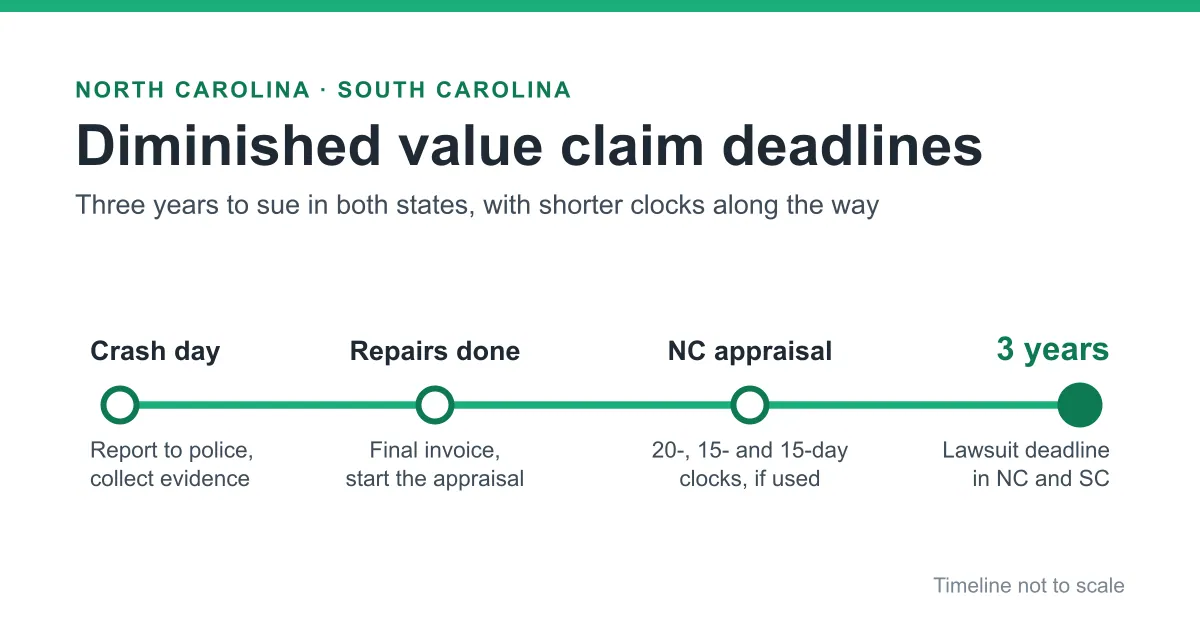
In both North Carolina and South Carolina, the main diminished value claim deadline is three years from the crash. That's how long you have to file a lawsuit against the at-fault driver if the insurer won't pay fairly for your car's lost value (N.C. Gen. Stat. § 1-52; S.C. Code § 15-3-530). Some shorter deadlines come first, and negotiating with the adjuster doesn't pause the three-year clock.
How long do you have to file a diminished value claim in NC and SC?
Both Carolinas give you three years to sue for damage to your vehicle, and diminished value is part of that damage.
North Carolina
North Carolina's three-year limit covers actions "for taking, detaining, converting or injuring any goods or chattels" (N.C. Gen. Stat. § 1-52). The clock starts when physical damage to your property becomes apparent, or reasonably should have. After a collision, that's the day of the crash.
North Carolina limits first-party diminished value, so most claims here go against the at-fault driver's insurer. Our guide to diminished value claims in North Carolina covers who can claim and how.
South Carolina
South Carolina also allows three years, for "an action for taking, detaining, or injuring any goods or chattels" (S.C. Code § 15-3-530). For a typical collision, count from the date of the crash.
| North Carolina | South Carolina | |
|---|---|---|
| Time to sue over vehicle damage, diminished value included | 3 years (G.S. 1-52(4)) | 3 years (S.C. Code 15-3-530(4)) |
| When the clock usually starts | When the damage becomes apparent, normally the crash date (G.S. 1-52(16)) | The crash date |
| Can your own policy shorten the time to sue? | No. Those conditions are void (G.S. 58-3-35) | No. You can still sue within the statutory period (S.C. Code 15-3-140) |
| Small claims ceiling | $10,000 (G.S. 7A-210) | $7,500 in magistrate court (S.C. Code 22-3-10) |
| Hit-and-run, driver never found | The UM statute names hit-and-run vehicles only for injuries, so car damage may fall to collision coverage (G.S. 20-279.21(b)(3)) | UM can pay for the damage if you report to police within a reasonable time and have physical contact, a witness affidavit or a recording (S.C. Code 38-77-170) |
Does opening a claim with the insurer stop the clock?
As a general rule, no. The three-year limit is the deadline to file a lawsuit. Reporting the claim, getting a claim number, sending a demand letter and trading offers with the adjuster all happen inside the insurance process, and none of them pause the statute of limitations.
Claims can stall for months. You send a demand, the adjuster asks for another document, and nothing moves. The date of loss on the insurer's file stays the same the whole time. Once three years pass, the at-fault driver can ask a court to dismiss a late lawsuit, and the insurer has little reason to keep talking.
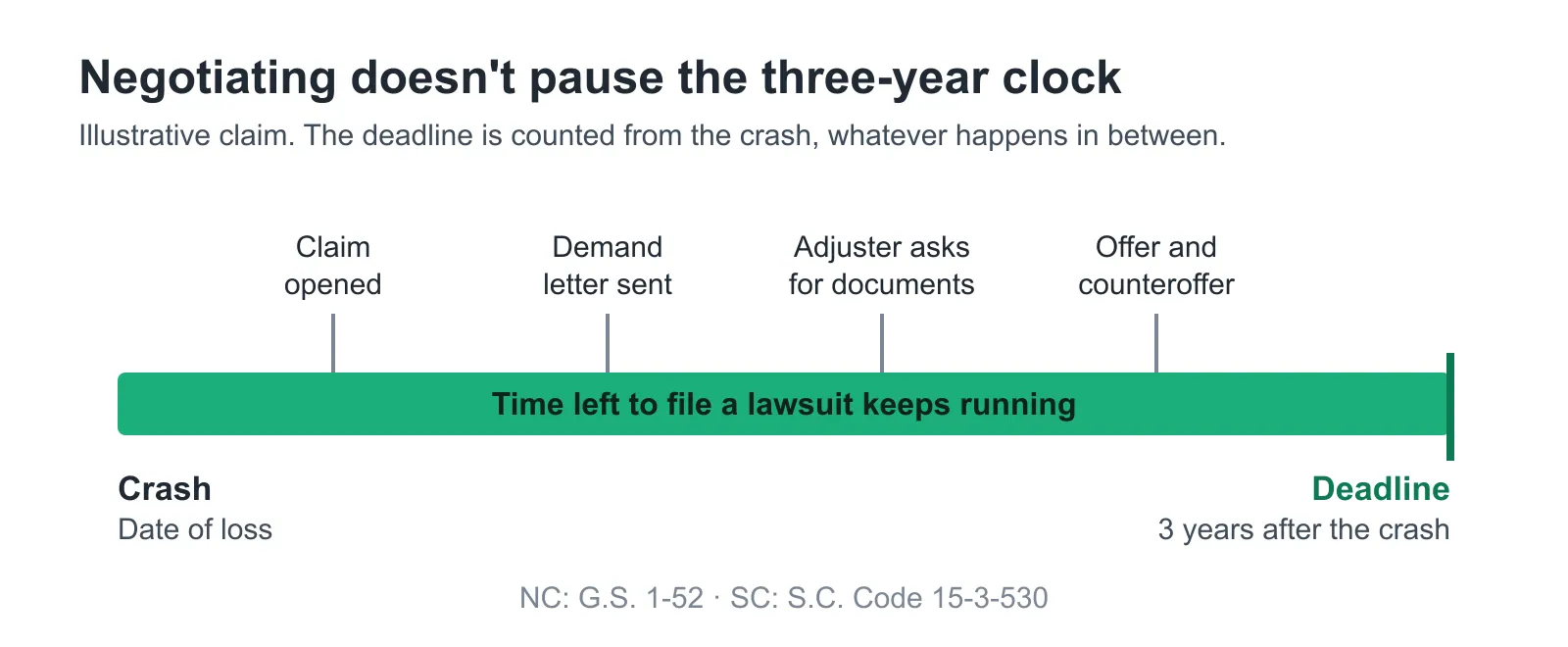
A slow adjuster doesn't buy you extra time either. North Carolina treats "failing to acknowledge and act reasonably promptly upon communications with respect to claims" as an unfair claim settlement practice when an insurer does it often enough to amount to a general business practice (G.S. 58-63-15(11)(b)). The statute sets no day count, and a violation doesn't by itself give you a right to sue. You can complain to the North Carolina Department of Insurance.
If you haven't put a number on the loss yet, start with a free diminished value quote.
Can your insurance policy give you less time?
Your policy can require prompt notice of a loss, but in both Carolinas it can't cut the time to sue below the period the law allows. That matters most in first-party claims, such as an uninsured motorist claim, where you claim under your own contract.
North Carolina
An insurer can't "limit the time within which any suit or action … may be commenced to less than the period prescribed by law," and policy conditions that try are void (N.C. Gen. Stat. § 58-3-35).
South Carolina
A contract clause that requires suit sooner than the statute of limitations doesn't bar a case brought within the statutory period (S.C. Code § 15-3-140).
Notice works differently. Most policies require you to report a loss promptly and cooperate with the investigation, and missing those duties can hurt a claim even when the lawsuit deadline is years away. Read the part of your policy that lists your duties after an accident. For how first-party claims work in each state, see first-party diminished value claims in NC and SC.
What deadlines does North Carolina's appraisal and umpire process add?
North Carolina's statutory appraisal and umpire process for diminished value disputes runs on deadlines counted in days. It comes from G.S. 20-279.21(d1) and applies when liability isn't disputed and you and the insurer are apart on the loss in value by more than $2,000 or 25% of the car's pre-accident fair market retail value, whichever is less.
- You or the insurer makes a written demand for appraisal.
- Within 20 days of the demand, each side picks a competent and disinterested appraiser and tells the other side who it is.
- If the two appraisers can't agree on the loss, an umpire decides it. When the appraisers can't agree on an umpire within 15 days, either side can ask a magistrate in the county where the car is registered, or where the crash happened, to choose one.
- After the report is filed, you and the insurer each have 15 days to reject it. A report nobody rejects in that window binds both of you.
- Each side pays its own appraiser, and the two sides split the other appraisal and umpire expenses equally.
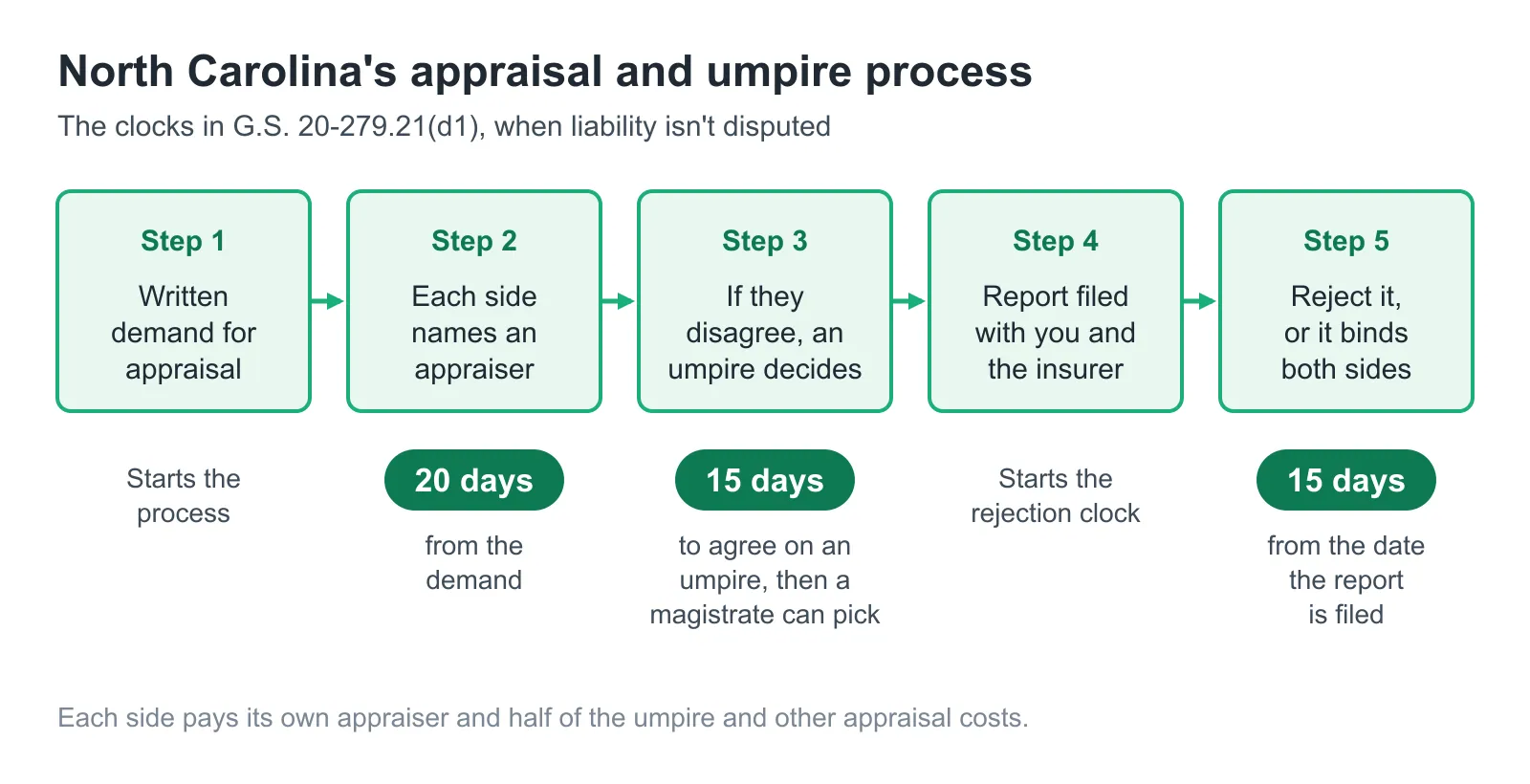
The rejection window is short. Write down the date the report is filed, and if you disagree with it, act inside those 15 days. Treat the three-year lawsuit limit as still running while the process plays out.
Diminished Value Carolina can act as your appraiser in this process through our claim settlement service. In that role we work as an appraiser; we don't give legal advice or act as your attorney. The (d1) process is North Carolina law. South Carolina claims follow the general deadlines above.
What changes after a hit-and-run?
After a hit-and-run, report the crash to police right away. With no driver to claim against, you'd be claiming under your own policy, and North and South Carolina handle that claim differently.
South Carolina
South Carolina's uninsured motorist (UM) statute allows a claim for property damage caused by an unknown driver only if these conditions are met (S.C. Code § 38-77-170):
- You, or someone for you, reported the accident to the police within a reasonable time.
- The unknown vehicle made physical contact with yours, someone other than your car's owner or driver saw the crash and signs an affidavit, or a recording shows the unknown vehicle caused the damage. If a witness won't sign, you can ask a court to order the witness's deposition before you sue.
- You weren't negligent in failing to identify the other driver and vehicle at the time of the crash.
North Carolina
North Carolina's UM statute mentions hit-and-run vehicles only in the bodily injury coverage. The property damage coverage refers to uninsured drivers and says nothing about hit-and-run vehicles (G.S. 20-279.21(b)(3)). If the driver is never found, damage to your car may fall to your collision coverage, if you carry it. North Carolina also limits first-party diminished value claims, so read your policy before you count on either coverage to pay for lost value.
If police later find the driver and the driver is insured, you can claim against that driver's insurer instead. Our post on hit-and-run accidents and diminished value in the Carolinas covers that situation.
When should you start a diminished value claim?
Start once repairs are finished and you have the final repair invoice. That's when an appraiser can compare what the car is worth now with what it was worth before the crash. Several things that happen between the crash and the three-year mark can narrow your options, so plan around them.
| When | What happens | What to do |
|---|---|---|
| The day of the crash | Evidence is easiest to collect | Get the police report number, photos and the other driver's insurance details. After a hit-and-run, report it to police right away |
| Before you sign anything | The insurer may send a property damage release | Read the wording first. Depending on how it's written, a release can settle the whole property damage claim, diminished value included |
| When repairs are done | The final repair invoice is ready, with any supplements | Use it to start the diminished value claim. The appraisal works from it |
| Before you sell or trade in | The car leaves your hands | Talk to an appraiser first, and read our guide on selling before a diminished value claim |
| During the NC appraisal process | The 20-day and 15-day clocks run | Write down each date as soon as its clock starts |
| Three years after the crash | The lawsuit deadline passes in both states | Get legal advice well before this date |
To start an appraisal, have these ready:
- The final repair bill or the insurance estimate, showing the claim number, date of loss, labor and parts, and mileage
- Your tag number, so the appraiser can pull a vehicle history report
- Any written offer or denial from the insurer
Find out what your car lost while there's still time
Diminished Value Carolina prepares independent, USPAP-compliant diminished value appraisals for drivers in North and South Carolina. Get Your Free Quote
This article explains general rules in North and South Carolina. It is not legal advice. For questions about your own deadline, consult an attorney.
Frequently asked questions
Can I still file a diminished value claim two years after my accident in NC or SC?
Usually, yes. North Carolina and South Carolina both allow three years to sue over vehicle damage, so a claim two years after the crash is still inside the limit, as long as you haven't signed a release that covers it. Move quickly, though. You need time to get an appraisal, send a demand and negotiate before the three-year mark.
Does filing an insurance claim stop the statute of limitations?
As a general rule, no. In North and South Carolina the statute of limitations is a deadline to file a lawsuit. Opening a claim, sending a demand letter and negotiating with the adjuster don't pause it. If talks are still going as the three-year mark gets close, an attorney can tell you how to protect the claim.
What happens if I miss the diminished value deadline?
If you file a lawsuit after the three-year limit in North or South Carolina, the at-fault driver can ask the court to dismiss it as time-barred. The insurer then has little reason to pay. A few narrow exceptions exist, so if you think you've missed the date, ask an attorney before you give up on the claim.
Is the deadline different for a claim against my own insurance company?
Claims under your own policy, such as uninsured motorist coverage, add policy duties like prompt notice. Neither state lets a policy shorten the time to sue below the period set by law (N.C. Gen. Stat. § 58-3-35; S.C. Code § 15-3-140). Check the notice terms in your policy early, and keep in mind that North Carolina limits first-party diminished value claims.
When should I get a diminished value appraisal after an accident?
Get the appraisal once repairs are finished and you have the final repair invoice, including any supplements. That's when an appraiser can measure the car's value after repair against its value before the crash. Starting early in the three-year window leaves time to negotiate and, in North Carolina, to use the statutory appraisal process if you need it.
Sources
- N.C. Gen. Stat. § 1-52 (three-year limit; accrual in subdivision 16)
- S.C. Code §§ 15-3-140 and 15-3-530 (contract clauses limiting time to sue; three-year limit)
- N.C. Gen. Stat. § 58-3-35 (insurer may not shorten time to sue)
- N.C. Gen. Stat. § 20-279.21(b)(3) and (d1) (UM coverage for hit-and-run vehicles; appraisal and umpire process)
- N.C. Gen. Stat. § 58-63-15(11) (unfair claim settlement practices)
- S.C. Code § 38-77-170 (UM recovery when the at-fault driver is unknown)
- N.C. Gen. Stat. § 7A-210 (small claims limit)
- S.C. Code § 22-3-10 (magistrate civil jurisdiction)